How do you handle negative Glassdoor reviews during a crisis?
Handle negative Glassdoor reviews during a crisis with the standard playbook, run faster: a measured employer response on each significant review that acknowledges what is fair and corrects factual errors without escalating; genuine, uncoached employee engagement that builds an accurate aggregate rating over time; owned culture content on the company's own properties; and reporting through Glassdoor's process only for reviews that actually break its policies. Wholesale suppression is rarely possible under Glassdoor's policies, and the attempt usually backfires.
Glassdoor responses during a crisis use the same playbook as any other time, run faster. There are four response paths and one common mistake to avoid.
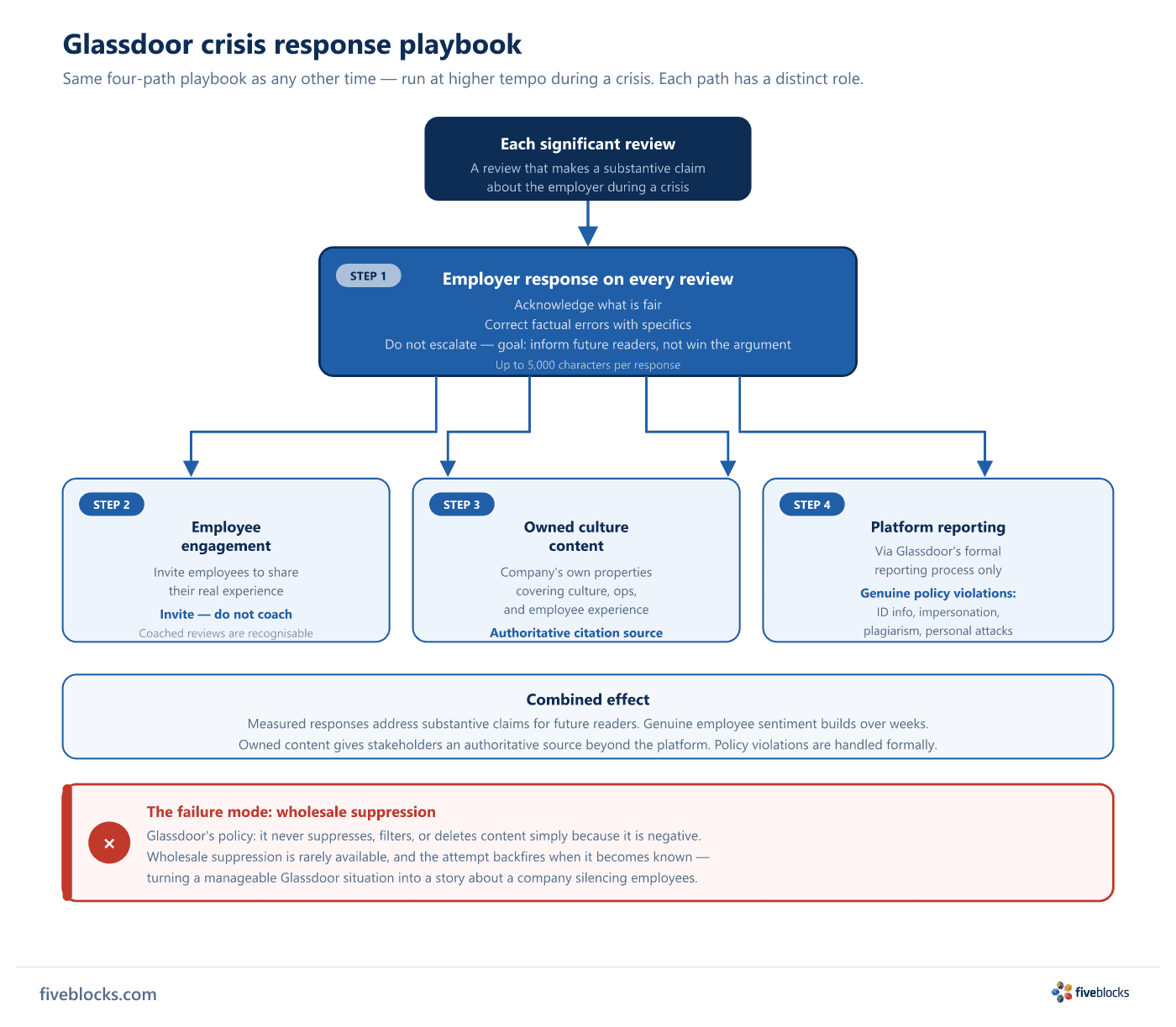
Step 1: respond to each significant review
Every review that makes a substantive claim gets a measured employer response. Acknowledge what is fair, correct factual errors with specifics, and do not escalate. Glassdoor gives employers up to 5,000 characters per response, which is enough to address the substance without starting a back-and-forth. The point is to show reasonable engagement to the people who read the review later, not to win an argument with the reviewer.
Step 2: invite employees, do not coach them
Ask current employees to share their actual experience on the platform. Inviting is not the same as coaching: telling employees what to say produces reviews that read as solicited and that Glassdoor’s moderation may flag. A genuine invitation, repeated over weeks, produces the volume and variety that give the platform an accurate aggregate rating and dilute a crisis-era spike of negative sentiment with the real baseline.
Step 3: build owned culture content for citation
Owned content about the company’s culture, operations, and employee experience belongs on the company’s own properties, where stakeholders who look past Glassdoor can find and cite it. More stakeholders do that research during a crisis. This content does not replace the platform response, but it gives those researchers a source that is not filtered through a third-party review site.
Step 4: report genuine policy violations through Glassdoor’s process
Report policy violations, identifying information, plagiarized content, impersonation, and personal attacks through Glassdoor’s formal reporting process. Glassdoor enforces its Community Guidelines and will remove content that meets its criteria. This path is only for reviews that actually break policy, not negative reviews the company disagrees with.
The mistake: wholesale suppression
What does not work, and what clients try routinely, is suppressing reviews wholesale. Glassdoor’s stated policy is that it never suppresses, filters, or deletes content simply because it is negative. Suppression is rarely possible under those policies, and the attempt usually backfires once it becomes known, turning a manageable Glassdoor situation into a story about a company trying to silence its employees.
Last reviewed: 19/05/2026
