What is the role of press coverage in shaping AI search results?
Press coverage in outlets AI engines weight: Reuters, Bloomberg, FT, WSJ, the New York Times, and their industry equivalents, reaches AI answers through two paths: direct retrieval, where RAG-based engines pull those pages in real time, and indirect amplification, where secondary outlets and aggregators summarize the primary story. The two paths feed each other, which is why concentrated press in weighted outlets has more AI-engine impact than the same coverage spread thin.
High-quality press coverage is one of the strongest non-Wikipedia signals for shaping what AI answer engines say about a brand. Coverage in outlets the engines weight: Reuters, Bloomberg, FT, WSJ, the New York Times, Washington Post, and the credible specialist press for a given industry, reaches AI responses through two paths. Both matter, and their effect is larger when the primary story is strong.
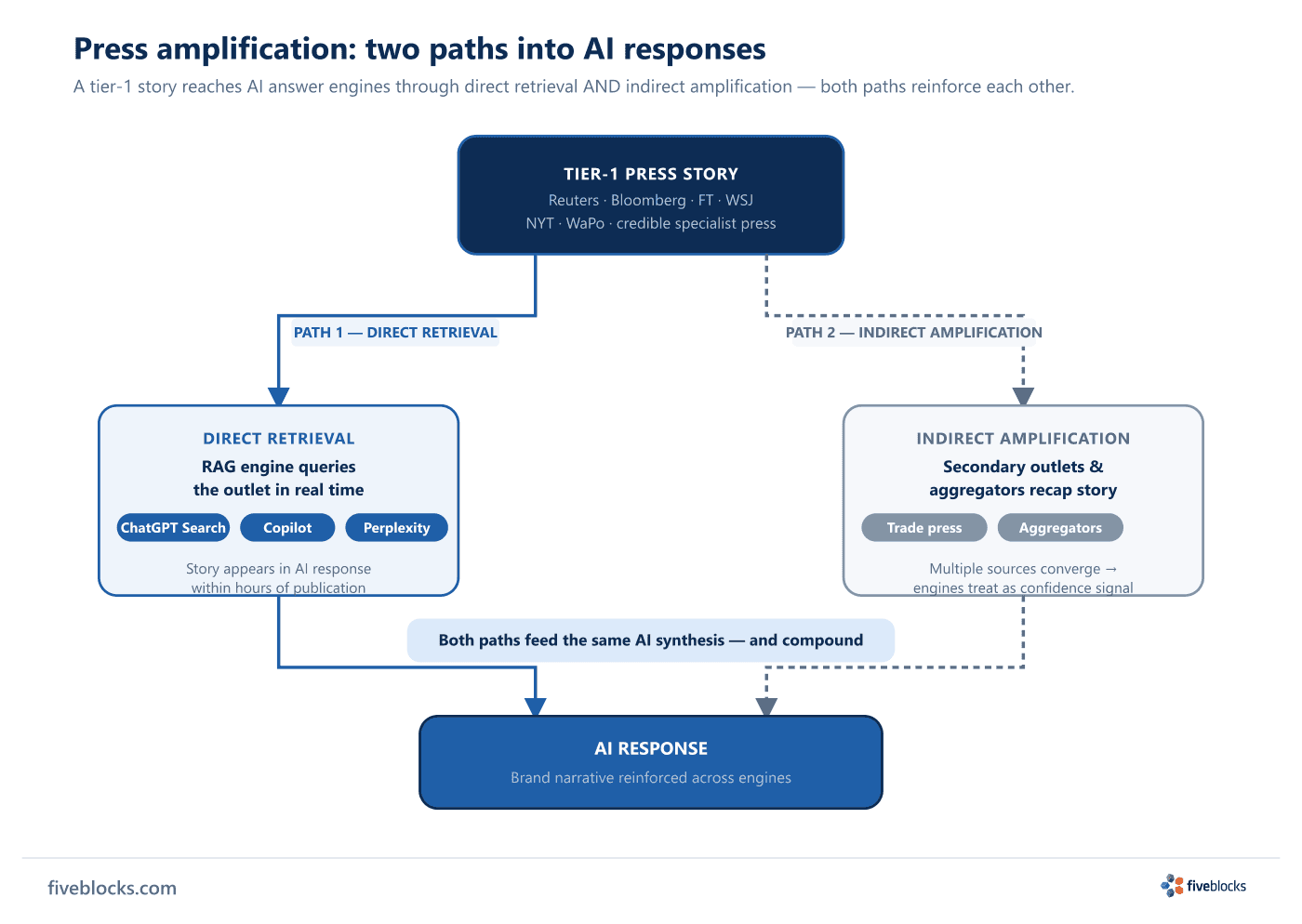
The two amplification paths
- Direct retrieval. RAG-based engines: ChatGPT Search, Microsoft Copilot, Perplexity, Google AI Overviews, run live web queries the moment a user’s prompt comes in. Authoritative news outlets are among the highest-weighted sources in those queries. A current story in a top-tier outlet can appear inside an AI response within hours of publication, rather than waiting for the next training cycle.
- Indirect amplification via secondary outlets and aggregators. Secondary sites, trade publications, and analyst summaries that recap primary press coverage are also retrieved by the engines as corroborating sources. When several sources agree on the same facts, the engines treat that agreement as a confidence signal. The primary story spreads through the source ecosystem and shows up again in the AI synthesis. (Note: this mechanism is well-observed in practice but does not yet have a directly cited published study confirming the exact weighting. Treat it as a reasonable inference from how retrieval systems work, not a measured finding.)
Why concentration matters more than volume
A few coordinated placements in weighted outlets tend to move AI answers more than the same news item covered thinly across many lower-authority sites. Engines favor earned media in credible third-party outlets over brand-owned pages and wire releases that get no third-party pickup. Volume without authority produces little AI-engine signal; authority without volume can still shift the synthesis.
The same dynamic applies in a crisis
A damaging story in a weighted outlet spreads through the secondary and aggregator layer as fast as a favorable one. Crisis response has to work at AI-engine speed: intervene at the source level before the secondary amplification cycle completes, not at the pace of a traditional press cycle.
Last reviewed: 19/05/2026
