How do AI search engines handle time-sensitive vs evergreen queries about brands?
Quick answer
AI search engines handle queries in two modes: time-sensitive queries (breaking news, recent events, current status) trigger retrieval, pulling from live web search, news APIs, and recently-indexed pages; evergreen queries (what a company does, who an executive is, background definitions) draw mostly from the training corpus and Wikipedia. A reputation program has to address both layers to avoid visible gaps in AI answers.
AI search engines do not treat all brand queries the same way. They route each query through one of two modes depending on whether the question is about something current or something stable. Which mode applies decides which content strategy will move the answer.
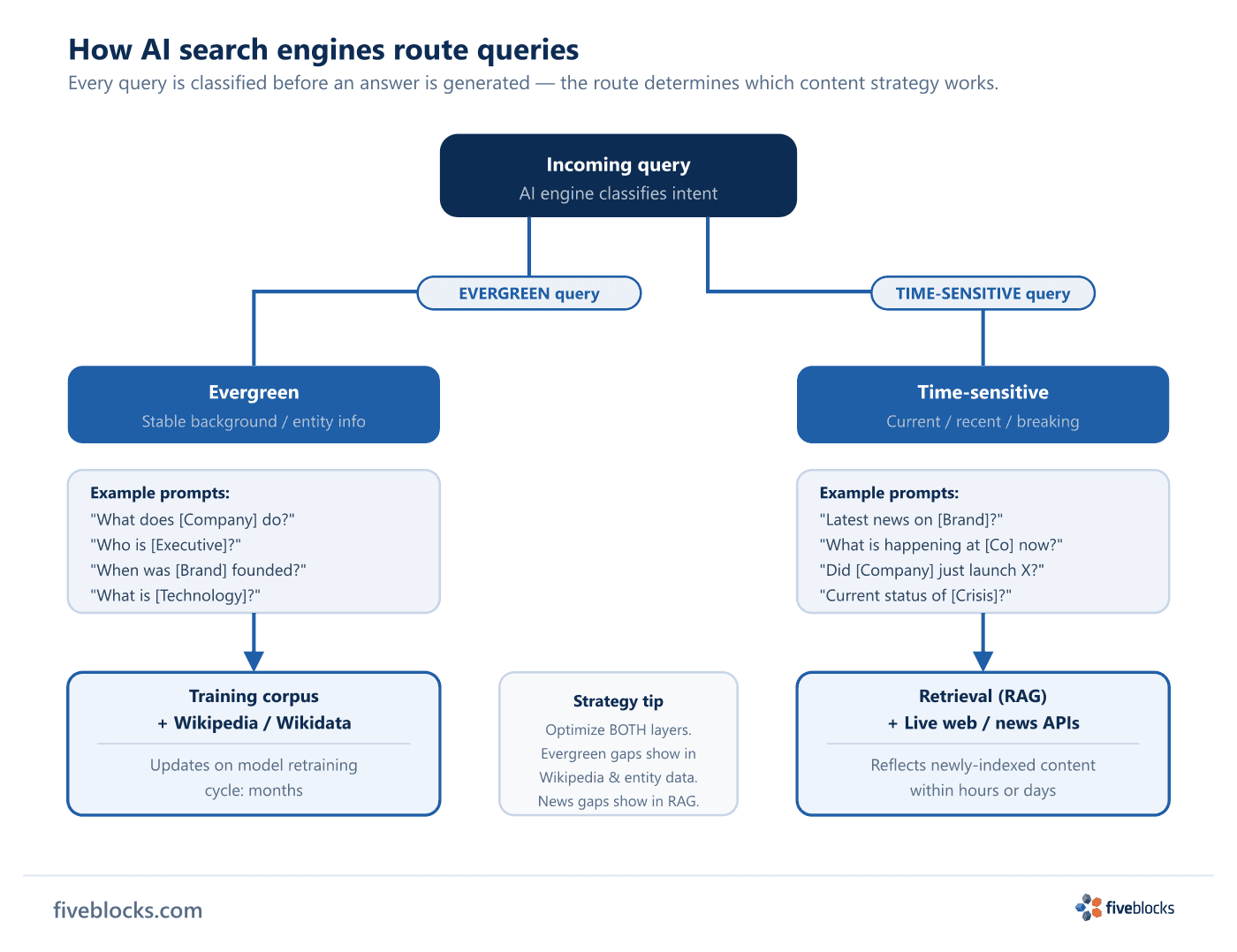
The two query modes compared
| Query type | Examples | Primary source layer | What moves the answer |
|---|---|---|---|
| Time-sensitive | “What is happening at [Company] now” “latest news on [Brand]” anything tied to a recent event, product launch, or crisis | Retrieval-augmented generation (RAG): live web search, news APIs, recently-indexed pages. Engines such as Perplexity, ChatGPT Search, Google AI Overviews, and Microsoft Copilot ground these answers in real-time web content. | Strong recent earned media coverage, fresh owned press releases indexed by search, and timely third-party reporting from authoritative outlets |
| Evergreen | “What is [Company]” “who is [Executive]” background, biography, and definitional questions with no time anchor | Training corpus and structured reference content: Wikipedia, the Google Knowledge Graph / Wikidata, and durable owned pages that were heavily indexed before the model’s training cutoff | A well-maintained Wikipedia article, strong entity infrastructure (Wikidata, Knowledge Graph), and durable owned content such as an About page or authoritative profile |
Why the split matters for reputation strategy
- Retrieval updates fast; training updates slowly. Retrieval-driven engines (Perplexity, Google AI Overviews, ChatGPT Search) reflect newly-indexed content within hours or days. Training-corpus answers change only when a model is retrained or fine-tuned, a cycle that runs months.
- Optimizing only one layer leaves a visible gap. A brand that invests only in earned media will have strong time-sensitive answers but thin or inaccurate evergreen answers if its Wikipedia article or entity data is outdated. The reverse holds too: strong entity infrastructure does little to shape answers about a breaking story.
- AIQ reporting shows the gap. Because AIQ polls engines on both types of queries, the gap between a brand’s evergreen and time-sensitive AI answers shows up directly in AIQ data, and it is a gap a CCO will eventually have to explain.
Last reviewed: 19/05/2026
