How do you handle Wikipedia categories and how do they affect visibility?
Wikipedia categories tag articles into a navigational hierarchy by industry, geography, organization type, and affiliation. Correct categorization affects reader discoverability, related-article navigation, and the entity signals that flow into Wikidata and the Google Knowledge Graph, sources AI engines actively read when generating answers. Miscategorization propagates the error into those downstream systems; corrections go through the standard Talk-page workflow.
Wikipedia’s category system organizes navigation across the encyclopedia. Every article is tagged into one or more categories, by industry, geography, type of organization, era of founding, notable affiliations, and so on, and those category assignments affect three things.
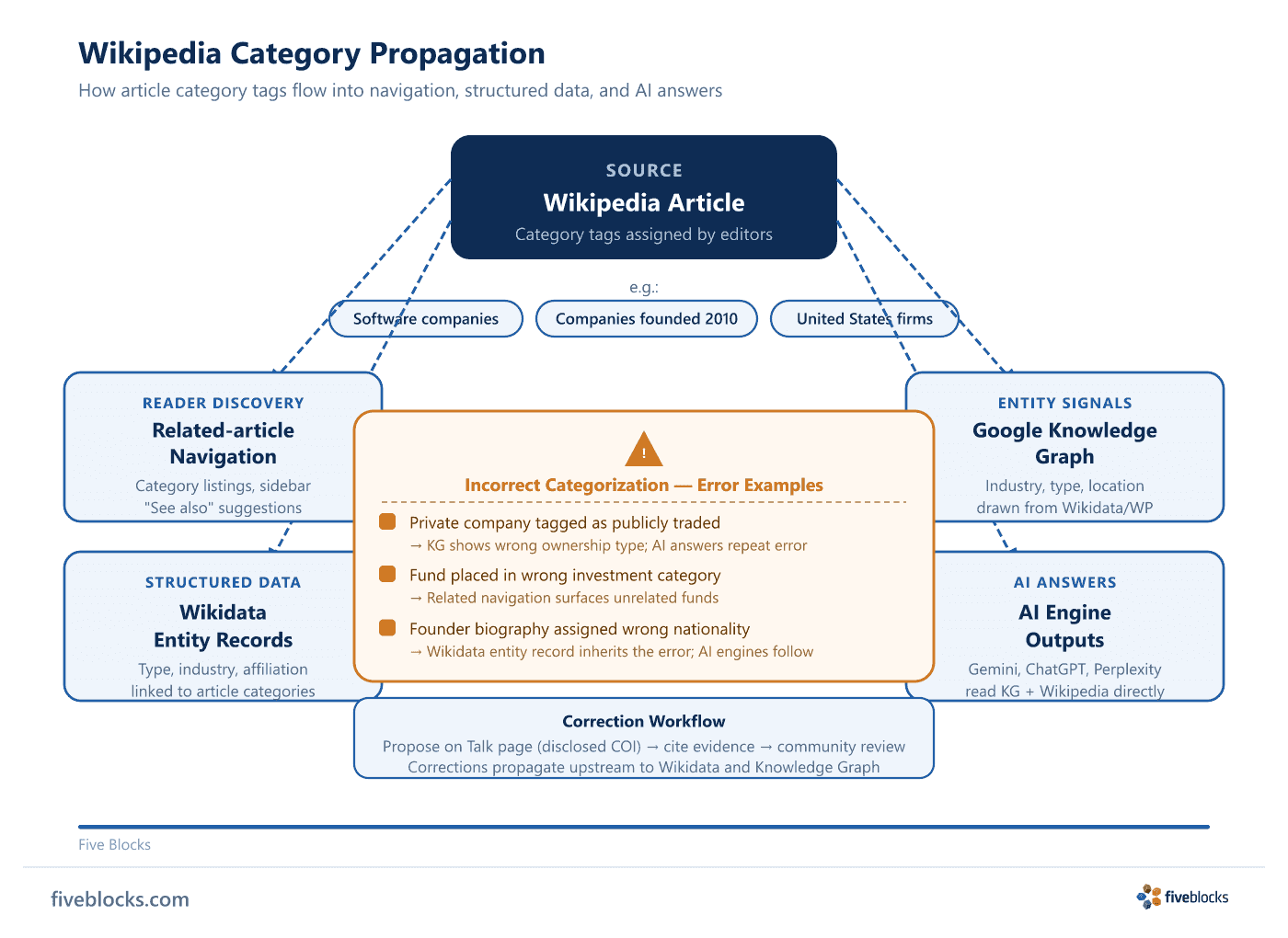
- 1. Reader discoverability
- Categories make an article findable by readers browsing a topic rather than searching by name. A company categorized in the correct industry and geography appears in the relevant category listings.
- 2. Related-article navigation
- Wikipedia’s sidebar navigation, “See also” sections, and algorithmic related-page suggestions are partly driven by shared category membership. Correct categorization places an article alongside genuinely similar entities.
- 3. Entity signals into Wikidata, the Knowledge Graph, and AI engines
- Wikipedia’s structured content, including category membership, flows into Wikidata and from there into the Google Knowledge Graph, which AI engines such as Gemini read when generating factual answers about companies, people, and organizations. Incorrect categorization (a private company tagged as public, a fund placed in the wrong investment category, a founder’s biography assigned the wrong nationality) carries that error into downstream systems and can surface in AI-generated descriptions.
Correcting a category error
Category corrections follow the same disclosed-COI Talk-page workflow as any other article change: propose the correction with the account, cite the supporting evidence (company filings, authoritative third-party sources), and wait for community editors to review and implement. Editors should not make category changes directly if they have a conflict of interest with the subject.
Last reviewed: 19/05/2026
