How do you handle a Wikipedia page that was previously deleted?
Previously deleted Wikipedia articles can be recreated only when the underlying notability has materially changed. The two proper paths are deletion review (when the original deletion was procedurally flawed or significant new evidence has emerged) and a fresh Articles for Creation draft (built on new reliable sources that postdate the deletion). Direct recreation without new notability evidence produces another deletion, often faster because the prior deletion is already on record.
Wikipedia tracks every deletion, and recreating an article through the same channels that produced the deletion will produce another deletion. The right starting point is an honest readiness assessment: has the source record changed materially since the original deletion, or not?
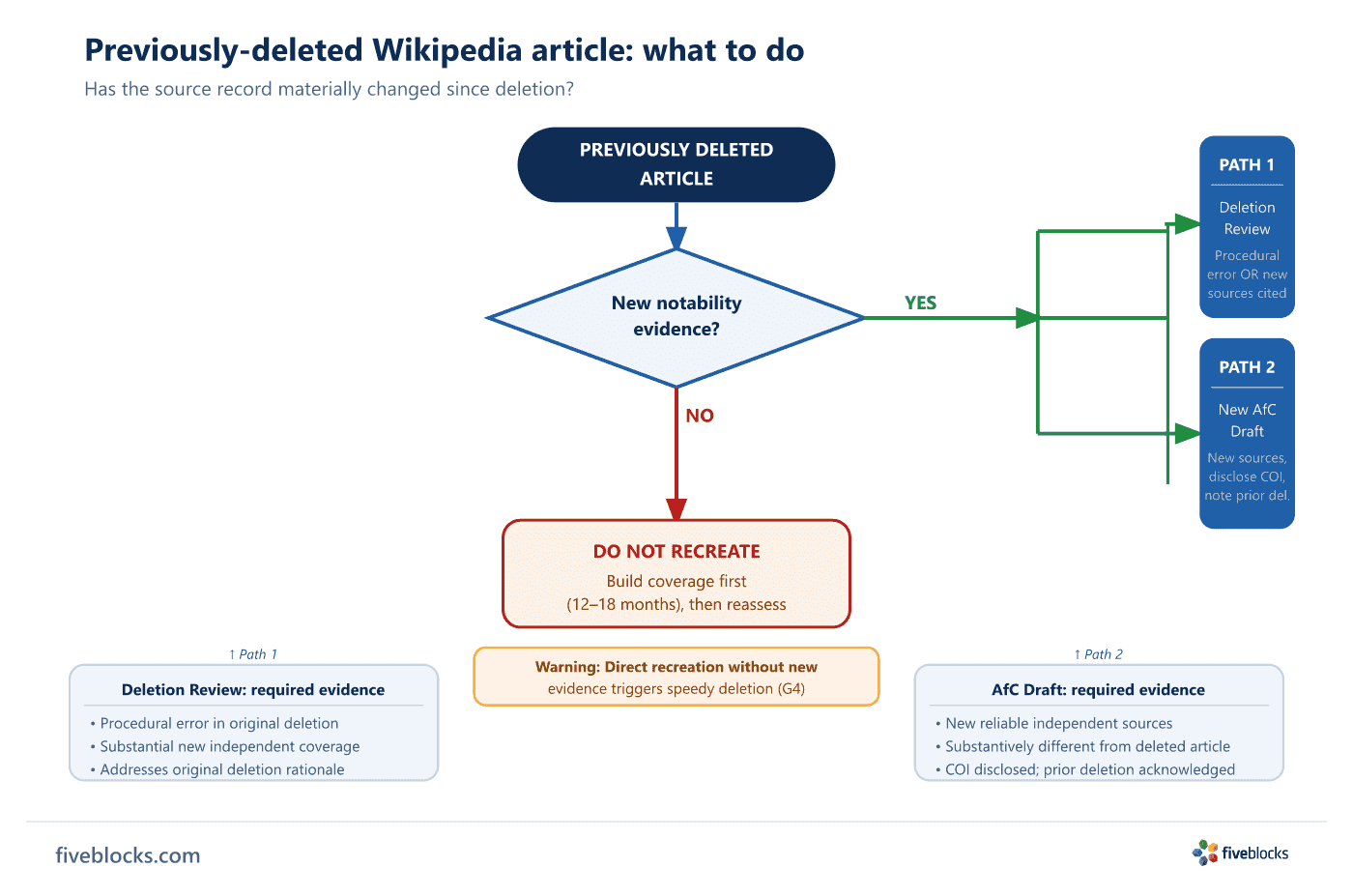
Path 1: deletion review
Deletion review is a formal process that asks the Wikipedia community to revisit the original deletion decision. It applies in two situations:
- Procedural error. The deletion followed a flawed process (wrong deletion type applied, insufficient community discussion, relevant policies misread).
- Significant new evidence. Material information has emerged that changes the notability picture, usually substantial new coverage in reliable independent sources that postdates the deletion and addresses whatever the original deletion rationale identified as missing.
Deletion review is not a way to relitigate a community consensus that was correctly reached. Without procedural error or materially new evidence, the review closes as “endorse” and the deletion stands.
Path 2: new Articles for Creation (AfC) draft
A new draft through Articles for Creation is the right path when genuine new notability evidence exists but deletion review is not the correct vehicle. A viable AfC submission on a previously deleted subject requires:
- A draft that is substantively different from the deleted article, not a rewrite of the same content.
- Sourcing built on new reliable independent secondary sources, ideally published after the original deletion, that meet the notability bar the prior article failed.
- Disclosure of any conflict of interest on the Talk page at submission.
- Explicit acknowledgment of the prior deletion in the submission notes, with an explanation of how the new sources address the gap.
Reviewers know the deletion history and will check it. An AfC submission that looks like the deleted article with minor edits is declined quickly.
What does not work
- Direct recreation without changes. Wikipedia’s speedy-deletion criterion G4 covers recreation of previously deleted content without substantial change; the article can be deleted within minutes.
- Reframing the same sources. Presenting the same pre-deletion source set in a different order or with added summaries does not meet the new-evidence threshold.
- Waiting for the editor community to forget. The deletion is permanently in the article’s history and visible to any reviewer.
The right first step
Before choosing a path, run a notability readiness assessment to judge whether the source record has changed enough to support either route. If it has not, the work shifts to building coverage, typically a 12 to 18 month program of authoritative third-party press, analyst coverage, and entity-signal development, before attempting recreation.
Last reviewed: 19/05/2026
