How do you track media mentions and their impact on search?
Track media mentions by capturing them through monitoring tools, classifying them by outlet authority and sentiment, measuring whether the coverage actually ranks for branded queries, and correlating that with broader reputation metrics over time. Most tracking skips the ranking check, and it is the one that matters most: coverage that never surfaces in search does little for digital reputation.
Tracking media mentions and their search impact ties earned coverage to the reputation layers it actually moves, instead of treating press as an end in itself. Judge coverage by what it does to the result set, the AI narrative, and the entity signals, not by mention counts. The work runs in four steps.
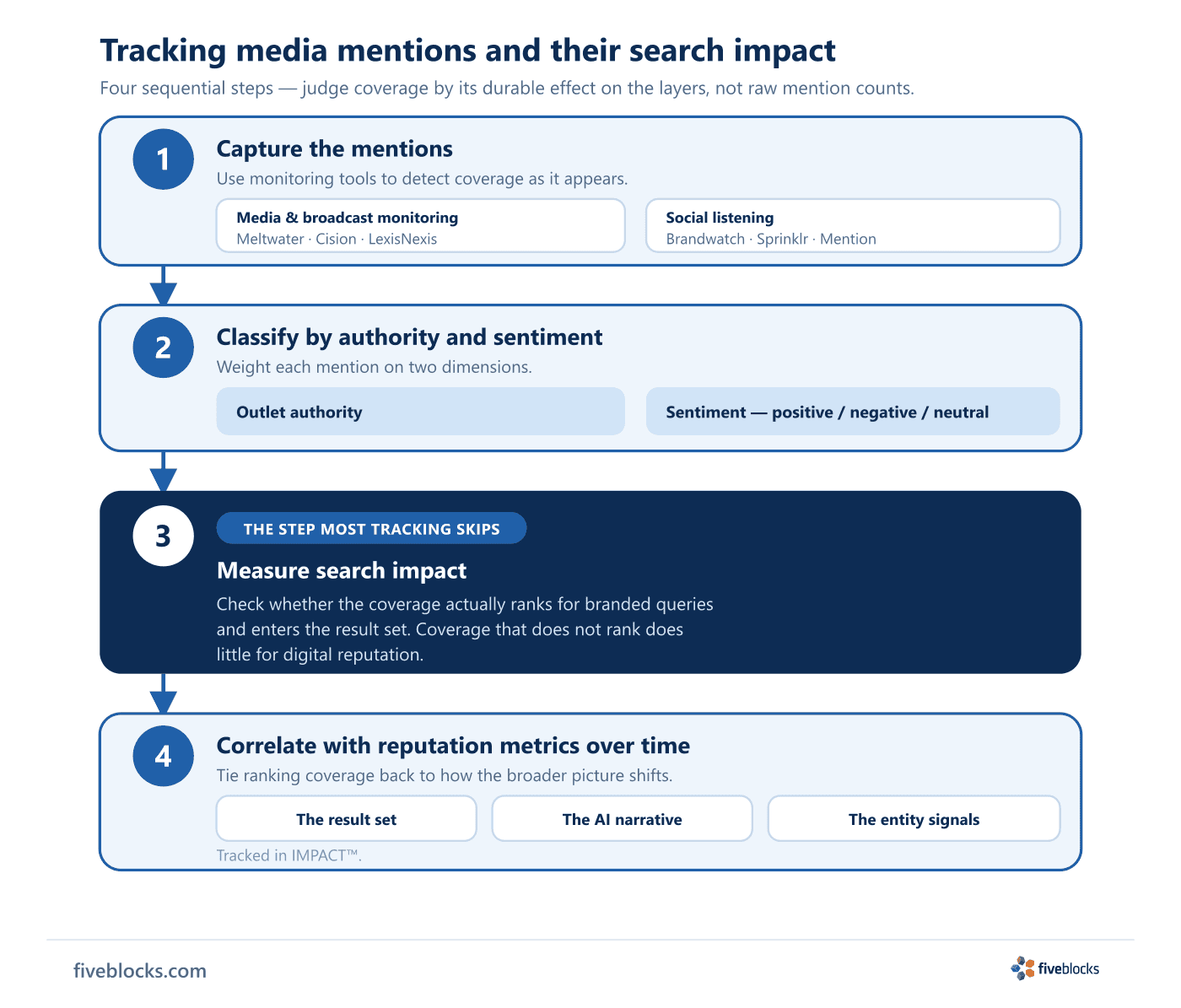
How to track media mentions and their search impact
- Capture the mentions. Media-monitoring tools detect coverage as it appears. Meltwater, Cision, and LexisNexis cover traditional and broadcast monitoring: they scan outlets and alert on brand mentions. Brandwatch, Sprinklr, and Mention track mentions and shifts in conversation across social platforms.
- Classify by authority and sentiment. Weight each mention on two dimensions. The first is the authority of the outlet: a top-tier publication carries far more signal than a low-authority one, and AI answer engines bias toward earned coverage from credible third-party outlets over brand-owned and social content. The second is sentiment (positive, negative, or neutral). Treat automated sentiment as directional rather than exact. The same content can be scored differently across models and prompts, and classifiers still struggle with nuance, sarcasm, and context.
- Measure search impact, the step most tracking skips. Check whether the coverage ranks for the branded queries and enters the result set. Coverage that does not rank does little for digital reputation even if it reached its print or online audience. A single article from a major outlet can dominate the news component of a branded search result set, and an unaddressed negative article from a major outlet can hold a top-page branded position for years.
- Correlate with reputation metrics over time. Tie the coverage that ranks back to movement in the result set, the AI narrative, and the entity signals. That is what shows which coverage durably moves the layers.
We track this in IMPACT™: which coverage ranks, and how the overall picture shifts.
Last reviewed: 20/05/2026