How do you monitor for brand impersonation and fake accounts?
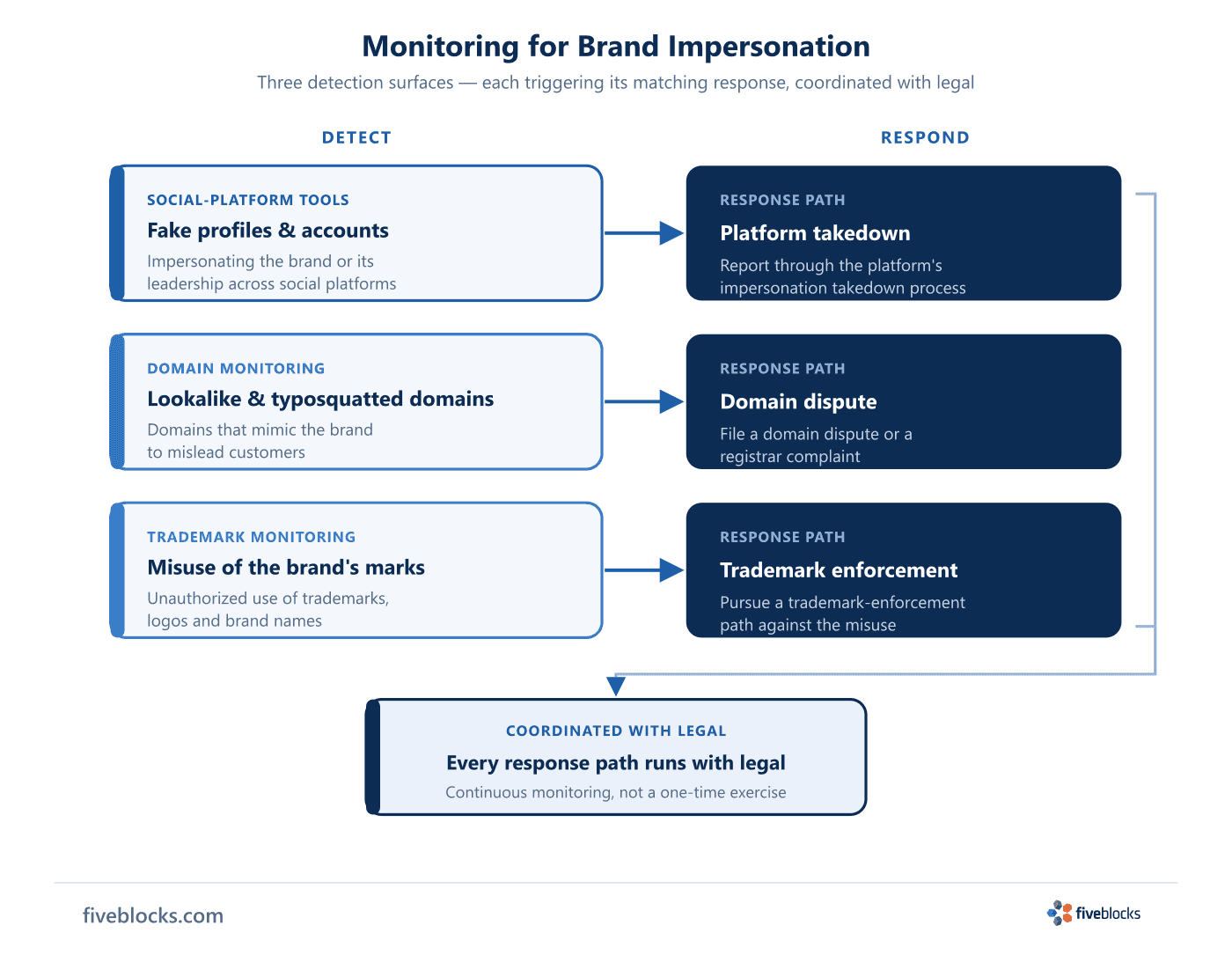
Watch three channels: social-platform tools for fake profiles, domain-monitoring services for lookalike and typosquatted domains, and trademark-monitoring services for misuse of the brand's marks. Each detection feeds its own response path (platform takedown, domain dispute, or trademark enforcement), run with legal.
Brand impersonation monitoring is a defensive watch: find the impersonator early, before it does damage. A fake account left running can defraud customers, erode trust in the real brand, and give hostile actors material to work with. The damage grows the longer the impersonation operates and the more people it reaches, so the watch covers the places impersonation appears and ties every detection to a response that is already defined.
Where to watch: three detection surfaces
- Social-platform tools catch fake profiles and accounts impersonating the brand or its leadership. Social platforms are where impersonation tends to multiply.
- Domain-monitoring services flag lookalike and typosquatted domains built to mimic the brand and mislead customers.
- Trademark-monitoring services surface unauthorized use of the brand’s marks.
How each detection triggers a response
Detection matters only if it connects to action quickly. Each surface has its own enforcement path, usually run with legal:
| What is detected | Response path |
|---|---|
| Fake account or profile | The platform’s takedown process |
| Lookalike or typosquatted domain | A domain dispute or registrar complaint |
| Misuse of the brand’s marks | A trademark-enforcement path |
Why the watch has to be continuous
Impersonation is an ongoing condition rather than a single event, so the work is continuous watching plus a response process that is ready before it is needed. When impersonation monitoring sits inside the broader reputation program, detection stays connected to action and a threat gets handled before it spreads.
Last reviewed: 20/05/2026
