How do you manage reviews for a company that operates under multiple brand names?
Assign named owners per brand, monitor each brand's scores separately, and make sure the entity signals on your owned properties cleanly attribute each brand to its own identity. The core risk is the brands blurring together in search and AI.
A company operating under multiple brand names has a review problem and an entity problem at once: the brands have to be managed separately, and they have to stay distinct in how search and the AI engines understand them. Run the two sides in parallel. The entity side is where multi-brand companies most often slip.
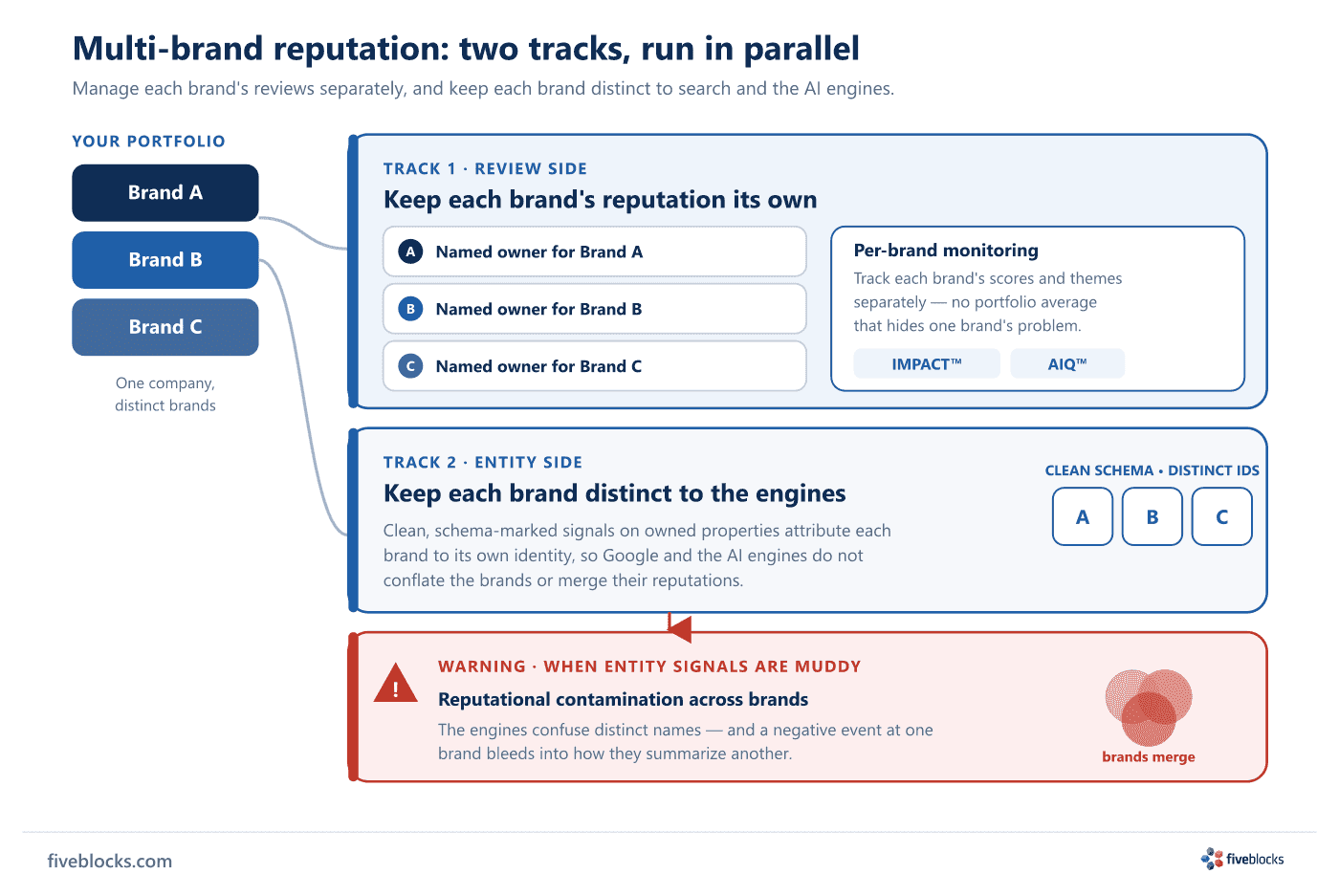
The review side: keep each brand’s reputation its own
- Named owners per brand
- Each brand has someone accountable for its reviews, rather than a single queue that treats the portfolio as one entity.
- Per-brand monitoring of scores and themes
- A problem at one brand should not be averaged away in a portfolio number or, worse, attributed to a sibling brand.
The entity side: keep each brand distinct to the engines
- Clean, schema-marked signals on owned properties
- Owned pages need structured data that attributes each brand to its own identity, so Google and the AI engines do not conflate them or merge their reputations.
- The contamination risk when signals are muddy
- When the entity infrastructure is weak, the engines can confuse distinct names, and a negative event at one brand can bleed into their summaries of another.
We track each brand’s search presence with IMPACT™ and how the AI engines describe each one with AIQ. The core risk in a multi-brand structure is reputational contamination across brands that should stay distinct.
Last reviewed: 20/05/2026
