How should wealth advisors manage their online presence?
Build the presence in layers: a credentialed bio marked up with Person schema, content that stays inside FINRA Rule 2210's fair-and-balanced standard, listings in authoritative advisor directories, and steady planning-focused thought leadership tied to your name. The aim is that a prospect searching your name finds the accurate, credible version of you.
Prospects read a wealth advisor’s online presence while deciding whether to hand over money, so the bar is trust, not visibility for its own sake. Build it in layers, each one feeding what a prospect sees on a name search.
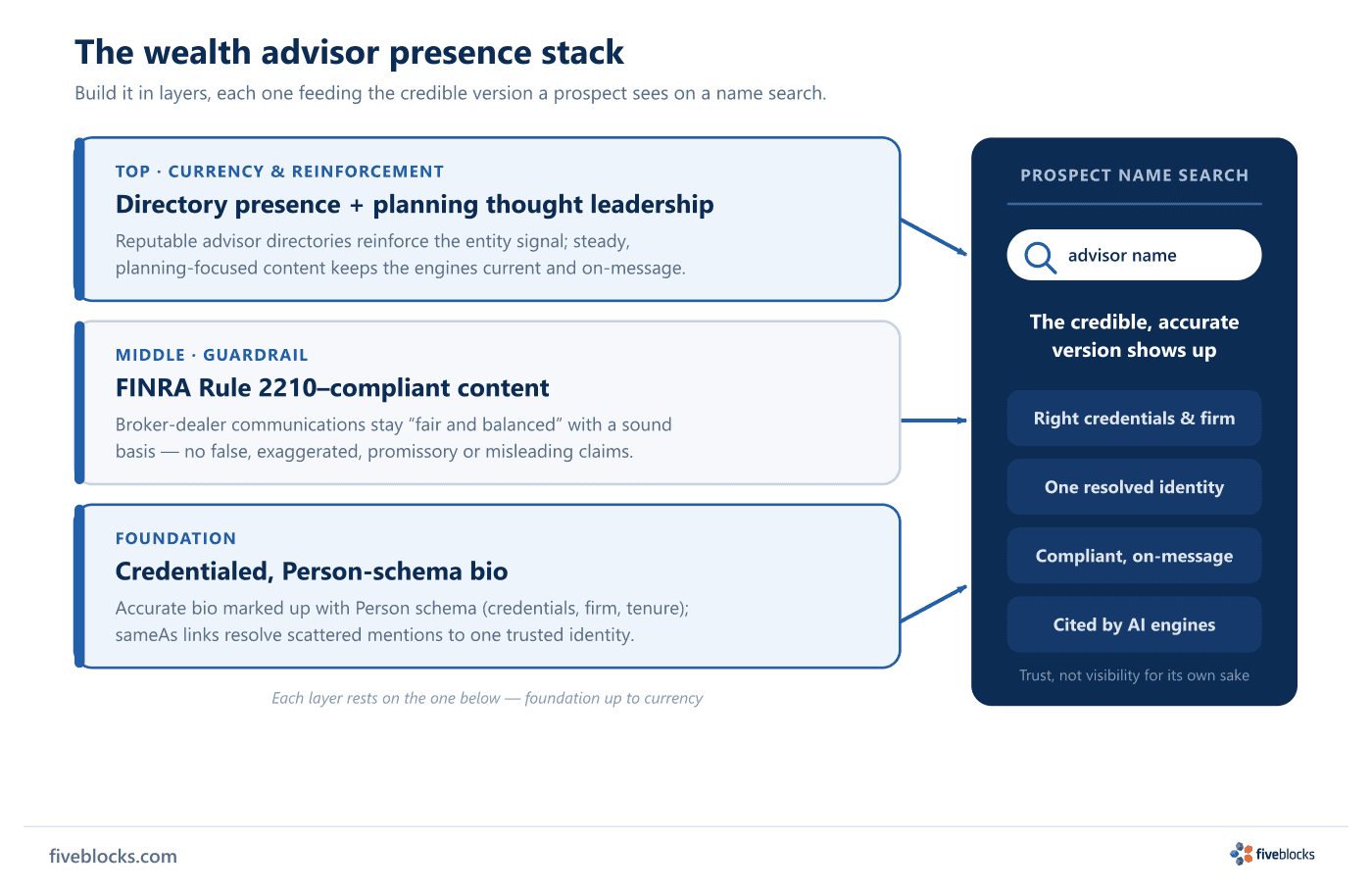
1. Foundation: a credentialed, schema-marked bio
Start with an accurate bio marked up with Person schema so search engines and AI engines render the right facts: credentials, firm, tenure, and areas of focus. Add sameAs links from that bio to authoritative references, and the engines can resolve scattered mentions to one identity with higher confidence. That disambiguation compounds over time. Named, credentialed authorship also makes content more likely to be cited by AI engines.
2. Guardrail: keep content inside FINRA Rule 2210
For broker-dealer communications, the content has to live inside FINRA’s marketing rules. Rule 2210 governs communications with the public. It sets the standard that everything be “fair and balanced” and provide a sound basis for evaluating the facts, and it prohibits any “false, exaggerated, unwarranted, promissory or misleading” statement. That shapes how testimonials, endorsements, and performance references are handled, so the presence reads as authoritative without tripping the rule.
3. Reinforcement: authoritative advisor directories
Presence in reputable third-party directories reinforces the entity signal. Entity resolution is how Google and the AI engines decide that a LinkedIn profile, a press mention, and a directory listing all refer to the same person. A consistent, accurate listing in a credible directory strengthens that identity instead of diluting it.
4. Currency: planning-focused thought leadership
Steady, planning-focused thought leadership tied to the advisor’s name gives Google and the AI engines current, on-message material to draw on. Fact-dense, well-structured content with clear authorship and its own citations is the kind of material the engines tend to surface and cite.
When a prospect then searches the advisor, the accurate, credible version is what comes up.
Last reviewed: 20/05/2026
