What role does the client play during a reputation management engagement?
The client stays active throughout a reputation management engagement: supplying context and access to owned properties, joining strategy reviews, approving key content, stating goals and constraints, and coordinating internal teams such as PR, legal, and marketing. Programs underperform when the client disengages and treats the firm as a black box.
Reputation management engagements are collaborative. The firm does the specialized work, but it depends on the client for context, access, approvals, and internal coordination. When a program underperforms, client disengagement is usually the reason.
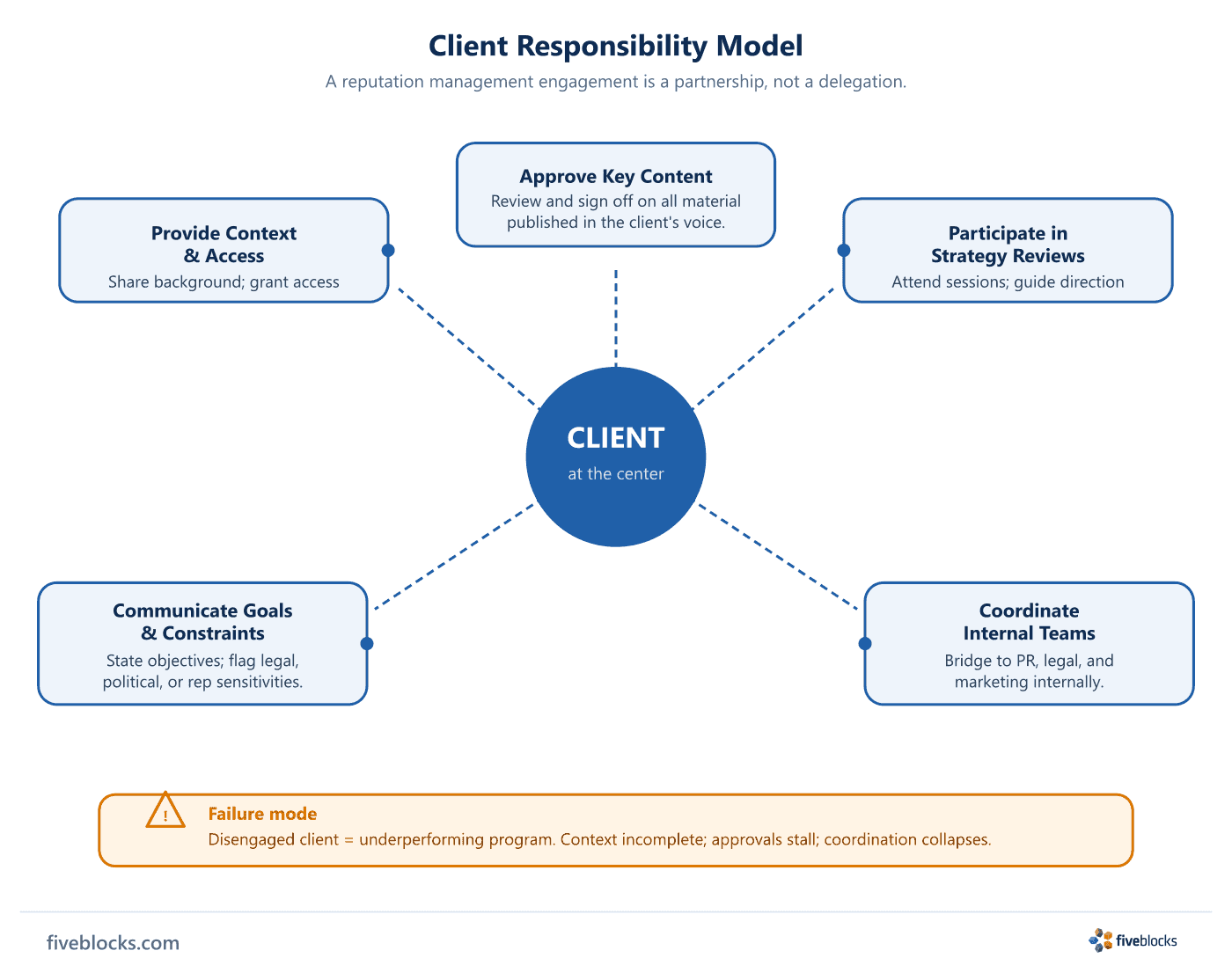
Core client responsibilities
- Provide context and access
- Share the background on the situation and grant access to the owned properties the firm will work on. Without both, the firm works from an incomplete picture.
- Participate in strategy reviews
- Show up for the regular strategy sessions and engage. Program direction should reflect the client’s judgment rather than the firm’s assumptions about it.
- Approve key content
- Review and sign off on material the firm writes in the client’s voice. Nothing gets published without client approval.
- Communicate goals and constraints
- State the objectives plainly and flag the sensitivities (legal, political, reputational) that shape what is appropriate to publish or pursue.
- Coordinate internal teams
- Be the internal bridge to PR, legal, and marketing so the reputation work reinforces what the rest of the organization is doing instead of cutting against it.
The failure mode: disengagement
A client who treats the engagement as a hands-off subscription cuts off the inputs the firm needs. Context stays incomplete, content approvals stall, and internal coordination breaks down. What comes out is technically correct work that doesn’t fit the client’s actual situation. Serious firms head this off by setting expectations about the client’s responsibilities at the start.
Last reviewed: 20/05/2026
