What is Google’s algorithm update history and how has it affected reputation management?
Google's major algorithm updates: Panda, Penguin, Hummingbird, BERT/MUM, Helpful Content, and recent AI integrations, have each closed off a specific class of manipulation while elevating a durable ranking signal in its place. The cumulative effect is that approaches relying on thin content, link networks, or keyword manipulation now return diminishing results, while authoritative content, accurate entity signals, and structural source work compound over time.
Every named Google algorithm update has done the same thing: it closed off a manipulation that briefly worked and elevated a signal that is harder to fake. The sequence explains why reputation programs built on structural authority hold up as the algorithm changes.
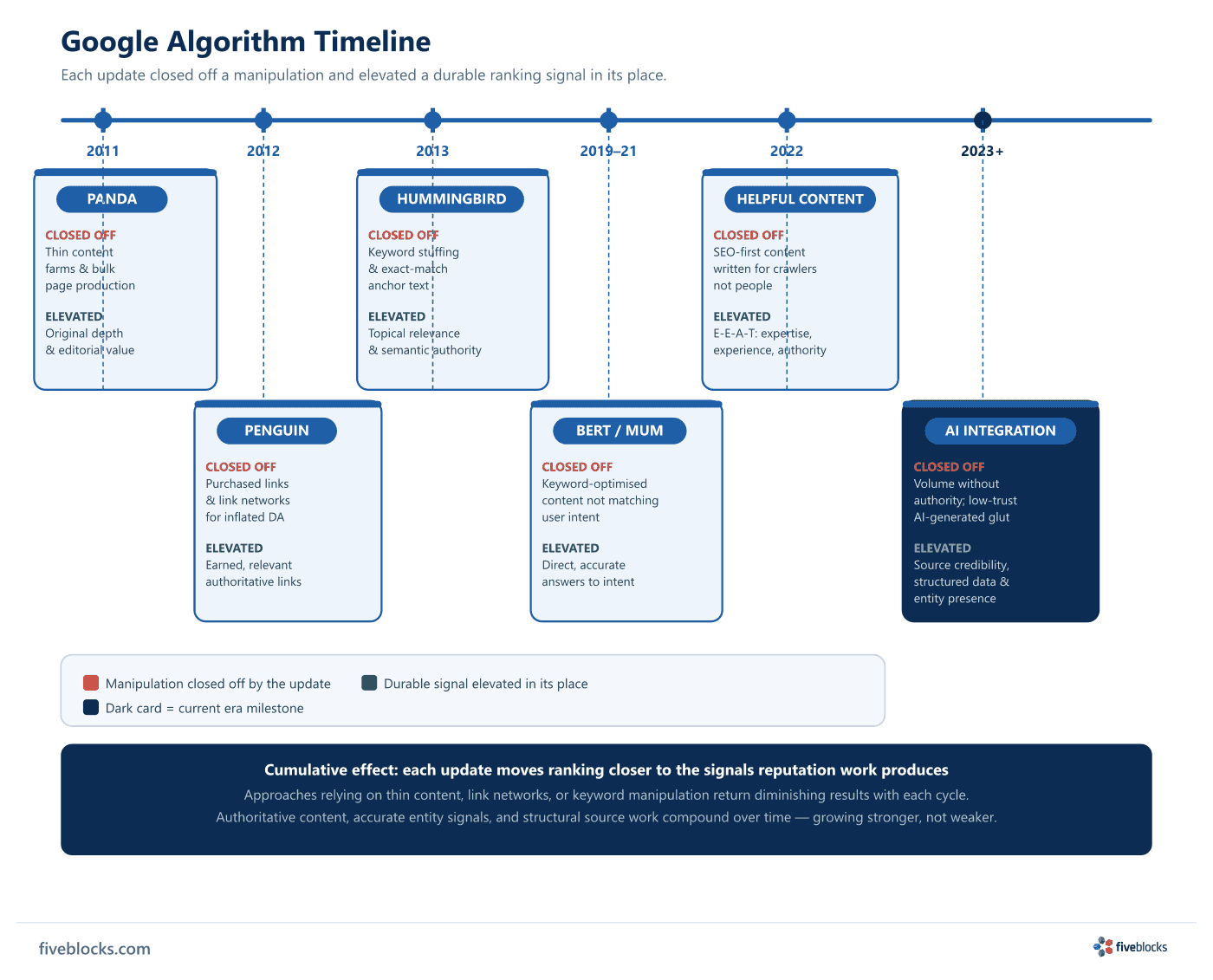
The major updates and what each one changed
-
Panda (2011, content quality)
Panda targeted thin content farms and low-value pages, sites copying content from others or publishing pages with little original value. The manipulation it closed off: bulk content production for ranking volume. The signal it elevated: genuine depth and original editorial value on each page.
-
Penguin (2012, link quality)
Penguin penalized manipulative link building: purchased links, link exchanges, and networks built purely to inflate authority scores. The manipulation it closed off: link quantity as a proxy for quality. The signal it elevated: natural, authoritative, relevant links earned on the merits of the underlying content.
-
Hummingbird (2013, semantic understanding)
Hummingbird shifted ranking away from exact-match keyword presence toward understanding the meaning behind queries, especially natural-language questions. The manipulation it closed off: keyword stuffing and exact-match anchor text. The signal it elevated: topical relevance and conceptual authority across a subject area.
-
BERT and MUM (2019 / 2021, natural-language interpretation)
BERT improved Google’s ability to interpret the full context of a word within a sentence; MUM extended this across 75 languages and multiple task types. Both reduced the ranking value of keyword-optimized content that did not actually answer user intent. The signal elevated: content that directly and accurately addresses what a user is trying to understand.
-
Helpful Content updates (2022 onward, people-first content)
The Helpful Content system explicitly targets content written to manipulate search engine rankings rather than to benefit readers. Google’s stated standard: content should be created for people first, not for search engines. The manipulation closed off: SEO-optimized content with thin or derivative substance. The signal elevated: genuine expertise, experience, authoritativeness, and trustworthiness (E-E-A-T).
-
AI integrations (2023 onward, authority signals in generative results)
AI Overviews and other generative features draw on the same authority and entity signals that govern traditional ranking, with additional weight on clearly sourced, well-structured content that is easy for a model to extract and attribute. The manipulation closed off: volume without authority. The signal elevated: source credibility, structured data, and durable entity presence.
What this means for reputation management
- Approaches that briefly worked, link networks, content farms, keyword manipulation, low-quality syndication, now produce less return and more risk with each successive update.
- Work that survives and compounds is structural: authoritative content, accurate entity signals, durable owned properties, source-level remediation.
- Programs built on that foundation get more resilient with each update. Every algorithm change has moved ranking closer to the signals reputation work produces.
Last reviewed: 19/05/2026
