How long before suppressed content stops ranking at all?
Suppression is a maintained outcome, not a permanent one. Suppressed content resurfaces when authoritative replacement content loses authority, when previously-deprecated sources gain new amplification, or when new events revive old coverage. Durable suppression takes sustained monitoring and active content maintenance, not a one-time intervention.
Suppression is a maintained outcome, not a permanent state of the algorithm. A negative result moves off page one because authoritative replacement content is outweighing it, and that balance of authority has to be actively preserved. The common mistake is treating a completed suppression as a closed project.
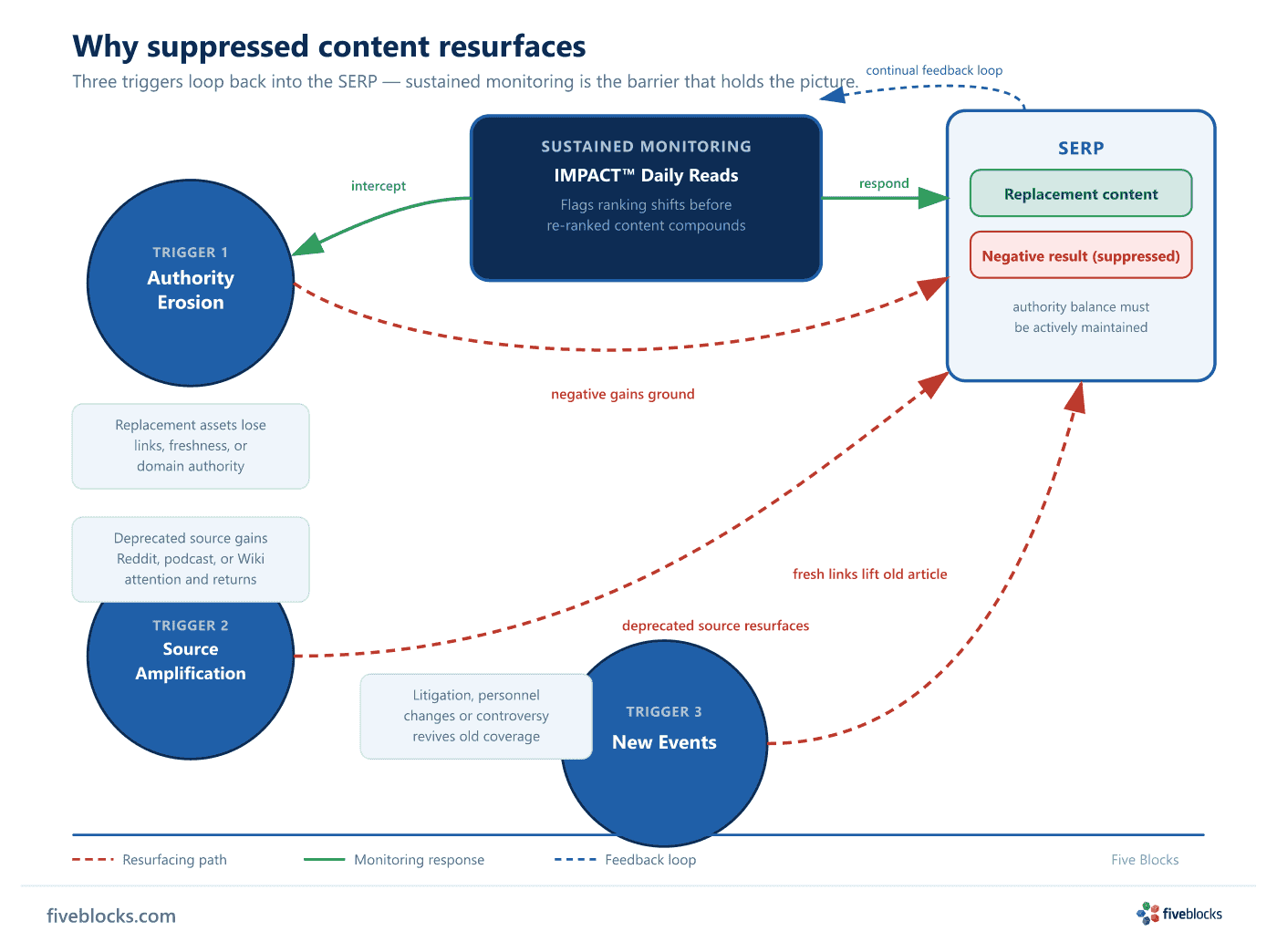
Why suppressed content resurfaces
- Authority erosion in replacement content. The assets that displaced the negative result hold their position through accumulated authority signals: domain authority, backlinks, freshness, and entity recognition. When those signals decay (a publishing outlet declines in citation count, a page goes dormant, or the Knowledge Graph reweights), the negative content below gains relative ground. Dormant websites lose ranking authority over time; sites that consistently update their best-performing content stay visible while competitors slowly fade from rankings.
- Source-level amplification of deprecated content. A previously-deprecated source can return to relevance through a podcast mention, a Wikipedia citation, or a Reddit thread that catches AI engine attention. Reddit and forum content has become more material to AI engine answers over the past two years, so a single active discussion thread can re-surface a source that had been effectively displaced.
- New events reviving old coverage. A new development, litigation update, personnel change, regulatory filing, or industry controversy can renew reader interest in legacy articles and generate fresh inbound links to them. When credentialed outlets publish about a social moment, the story enters Google’s news index and accumulates link authority and freshness signals, which can lift older related coverage as part of the same cluster. An unaddressed major-outlet negative article can hold a top-page branded SERP position for multiple years, and a new hook can restore one that had been pushed down.
Why real-time detection matters
How fast resurfacing happens determines whether you can respond in time. Retrieval-first AI engines such as Perplexity, Google AI Overviews, and ChatGPT Search retrieve from a continuously refreshed index and reflect newly amplified sources within minutes to hours of a publication gaining authority signals. Google’s traditional index responds more gradually to authority shifts, but a story that re-enters Google News can re-rank for the company name within days. Google Alerts, the default free tool, delays notifications, misses social and review coverage entirely, and does not capture AI engine narrative shifts at all. By the time a re-ranked result surfaces in an ad-hoc Google search, it has often already been cited by AI engines in answers delivered to stakeholders.
IMPACT runs daily reads and flags ranking shifts for monitored keywords, giving a consistent signal before re-ranked content has time to compound.
What sustained monitoring and maintenance requires
- Daily SERP monitoring for the name queries that matter, not periodic spot-checks.
- Active content maintenance to keep replacement assets current. Freshness and updated internal linking are ranking signals, not set-and-forget attributes.
- AI narrative monitoring across retrieval engines to catch source-level amplification before it turns into durable re-ranking.
- A defined response workflow so that when resurfacing is detected, the team can act within hours rather than waiting for a quarterly review cycle.
A suppression that closes when a result moves off page one will not hold. Treated as an ongoing operating discipline, it does.
Last reviewed: 19/05/2026
