How do you prepare for voice search and AI assistants?
Voice search and AI assistants favour content structured to be lifted as a direct spoken answer. FAQPage schema makes question-answer pairs machine-readable; strong entity signals (Wikidata, Knowledge Panel) let assistants identify the right source; and concise definitional answers, paired with HowTo schema for procedural queries, cover the main query patterns.
Voice search and AI assistant queries differ from standard typed search in one structural way: the engine needs a single, speakable answer rather than a list of links to evaluate. Every content and entity choice that follows should serve that goal and make the right answer easy to find, attribute, and extract.
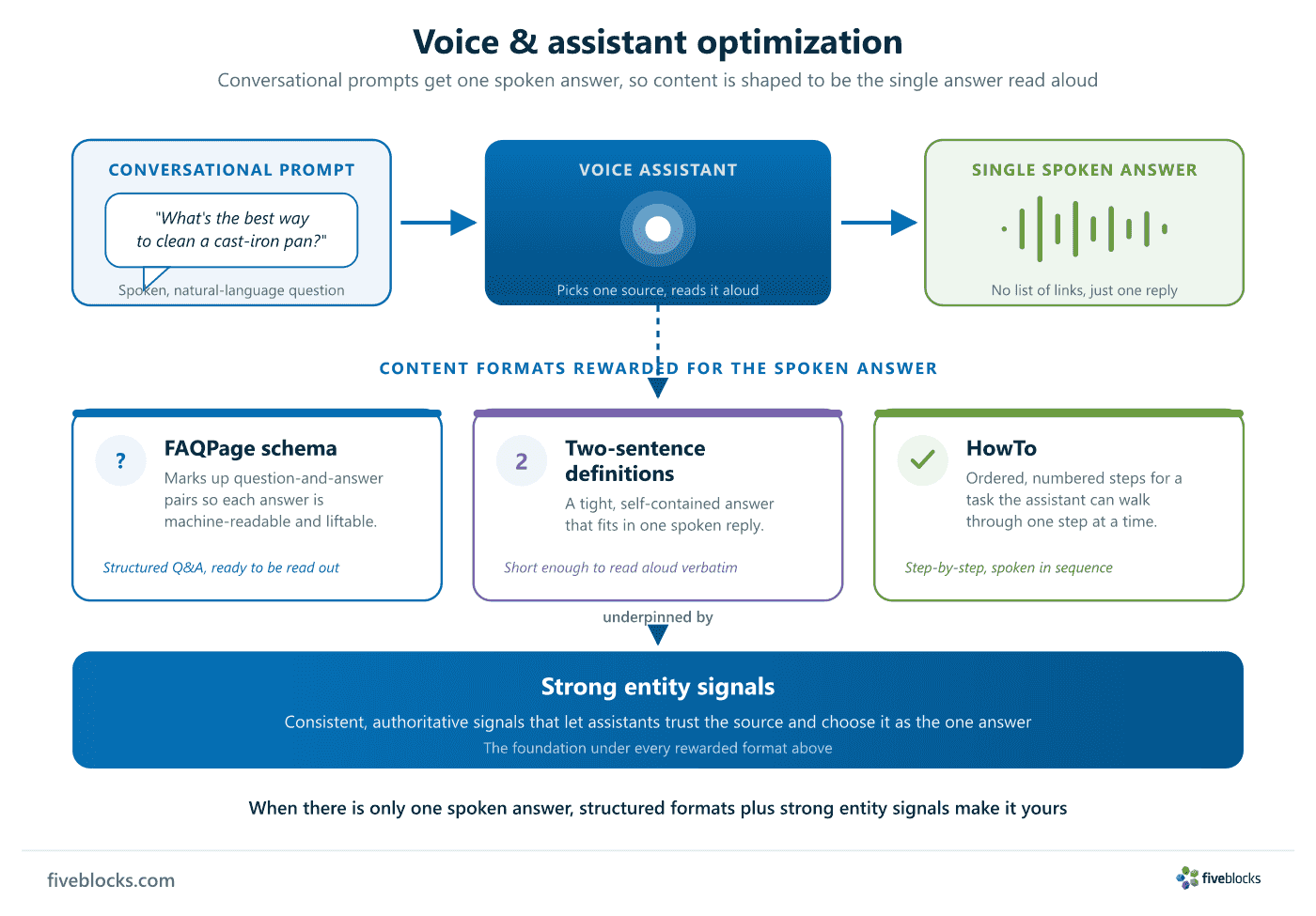
Step 1: Mark up Q&A content with FAQPage schema
FAQPage schema marks question-answer pairs as machine-readable, so AI models and assistant platforms can identify the content as structured Q&A and extract it cleanly. Google Search Central confirms that properly marked-up FAQ pages “may be eligible to have…an Action on the Google Assistant,” which ties the markup directly to assistant selection. The Schema.org FAQPage type defines the page as one presenting one or more “Frequently asked questions”, a signal the engine can act on without further interpretation.
Note: Google retired FAQ rich results in 2026, so FAQPage markup no longer produces a visual accordion in the standard Google SERP. The markup still helps because it makes page structure machine-readable for AI models (including Google’s own AI Overviews) and for other assistant platforms that did not adopt the same policy.
Step 2: Front-load concise definitional answers
Voice assistants and AI engines resolve entity and definitional queries by retrieving the clearest, most authoritative passage that answers the question. A clean two-to-three-sentence answer at the top of a topic page, before the surrounding context, cuts the interpretive work the engine has to do. Google’s featured-snippet and AI Overview systems use closely related selection logic and favour clean, extractable answers backed by source authority; pages that meet this bar tend to get cited more often across AI answer engines. The claim that definitional content “wins” these slots outright is not independently sourced. The mechanism (extractability plus source authority) is supported, but placement alone is not a guarantee.
Step 3: Use HowTo schema for procedural queries
Procedural voice queries (“how do I…”, “what are the steps to…”) are a distinct pattern. Numbered steps plus HowTo schema let AI engines extract the procedure cleanly: Schema.org defines HowTo as “instructions that explain how to achieve a result by performing a sequence of steps,” and Google Search Central confirms that structured data is “a standardized format for providing information about a page and classifying the page content.” Whether voice assistant platforms select HowTo schema at higher rates than plain prose is not independently supported in the research. The supportable basis for the recommendation is the extractability the markup provides.
Step 4: Build strong entity signals (Wikidata and Knowledge Panel)
Before an AI assistant can pick a piece of content as the right answer, it has to identify the entity the query is about. That identification relies on machine-readable entity signals. Wikidata is a free, collaboratively edited multilingual knowledge graph that “allows digital assistants (Siri, Alexa, Google) and bots to add and pull information from Wikidata and present it to their users.” A Google Knowledge Panel is “a primary source for direct answers” in voice search, not merely a search result. An accurate, complete Wikidata entry and a Knowledge Panel that reflects current facts are the base layer that makes the content-level steps above work.
Step 5: Connect the pieces with schema sameAs links
Schema markup on the site itself (Organization, Person, Article types) can carry sameAs links that point to the entity’s Wikidata entry, Wikipedia article, and official profile pages. This ties the entity together across the web and connects it to the canonical identifiers AI engines use for disambiguation. The Schema.org sameAs property is defined as a “URL of a reference Web page that unambiguously indicates the item’s identity,” citing Wikipedia and Wikidata as explicit examples. With accurate Wikidata and Knowledge Panel data, this gives the assistant a coherent, cross-referenced picture of the entity when it resolves a query.
Last reviewed: 19/05/2026
