How to Edit a Wikipedia Page Without Getting Reverted (or Making Things Worse)
Most company edits to Wikipedia get reverted within hours. Sometimes within minutes. The reason isn’t that the content was wrong, it’s that the edit violated a rule the company didn’t know existed. Here’s what you need to know before touching your Wikipedia page.
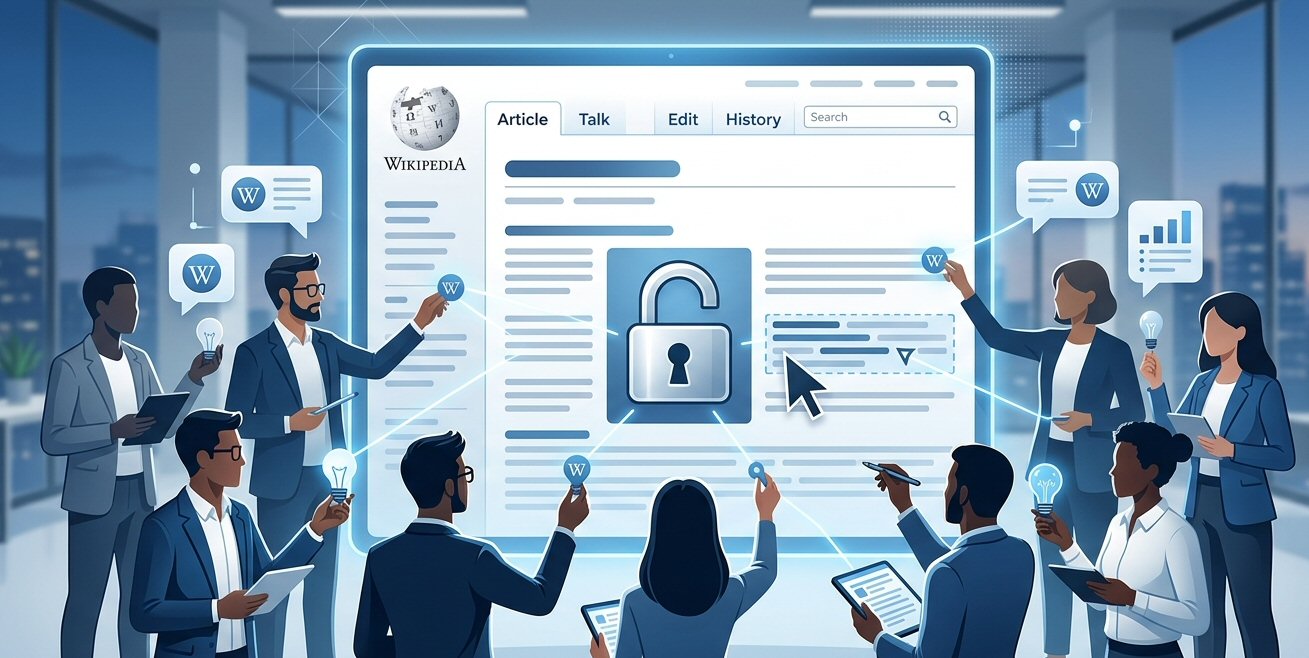
The Seven Reasons Your Wikipedia Edit Will Get Reverted
1. You Edited Without Disclosing Your Conflict of Interest
Wikipedia’s conflict of interest (COI) policy requires that anyone editing an article about their own company, employer, or clients must disclose that relationship. If you edit your own company’s Wikipedia page without disclosure, experienced editors will identify you, often through IP address lookup or account history, and revert your changes. The edit won’t just be removed; it may be flagged, and future edits from your account or IP may face extra scrutiny.
2. Your Source Doesn’t Meet Wikipedia’s Notability Standards
Wikipedia’s verifiability policy requires that content be supported by reliable, independent, secondary sources. A press release doesn’t count. Your company blog doesn’t count. Even a well-written article on your own website doesn’t count. The sources need to be from publications that are independent from the subject, newspapers, industry journals, academic publications, and established online media with editorial standards. If your source fails this test, the content will be removed regardless of how accurate it is.
3. The Tone Was Promotional
Wikipedia’s neutral point of view (NPOV) policy prohibits promotional language. Phrases like “industry-leading,” “best-in-class,” “award-winning,” or “pioneering” will trigger an immediate revert. So will superlatives, subjective claims, and anything that reads like marketing copy. Wikipedia editors are trained to spot promotional language, and they remove it systematically. Even factually accurate content can be reverted if the framing is promotional.
4. You Added Content That Lacks Independent Verification
This catches companies off guard. You know your own history better than anyone, but Wikipedia doesn’t accept your account of events as authoritative. If a fact about your company isn’t reported in an independent source, it can’t appear on your Wikipedia page, even if it’s completely true. Many companies try to add significant milestones, product launches, or leadership information only to have it removed because the event was never covered in qualifying external media.
5. The Edit Was Made by a New or Suspicious Account
Wikipedia’s editor community has developed sophisticated pattern recognition for detecting COI editing. A new account making significant changes to a corporate article is an immediate red flag. So is an account with no other editing history. So is an account that was clearly created specifically to edit one article. Automated bots and experienced human editors will flag and often revert these edits automatically.
6. You Removed Negative Information
Attempting to remove properly sourced negative information is one of the most common, and most quickly reversed, edits companies make. If there’s a documented controversy, legal issue, or negative coverage that’s been reported in reliable sources, that information belongs on the Wikipedia page. Removing it will be flagged as a clear COI edit, the information will be restored, and your attempted edit will be permanently recorded in the article’s history.
7. You Used Wikipedia’s “Edit” Button Rather Than the Talk Page
For anyone with a conflict of interest, the correct process is to request edits through the article’s Talk page rather than making direct edits. This is called the “edit request” process. When you bypass it and edit directly, you’re not just making a tactical error, you’re violating Wikipedia’s COI editing guidelines. The Talk page approach is slower, but it’s the only compliant method for interested parties.
Why This Matters Beyond Wikipedia
Wikipedia’s influence has expanded dramatically in the AI era. When someone asks an AI assistant about your company, the response is often grounded in your Wikipedia article. When Google displays a Knowledge Panel, the data comes largely from Wikipedia. When journalists research your company, Wikipedia is frequently their starting point.
A failed edit attempt that gets reverted and logged creates a permanent record. More importantly, it doesn’t solve the underlying problem, your Wikipedia page continues to say whatever it says, and that content continues to feed into every downstream platform that relies on Wikipedia as a data source.
The Professional Alternative
The disclosed COI approach is the only Wikipedia-sanctioned method for companies to engage with their own articles. It involves:
- Creating an account with disclosed affiliation
- Using the Talk page to request specific, sourced edits
- Engaging with the Wikipedia editor community transparently
- Building a record of good-faith participation
This approach works, but it requires understanding Wikipedia’s culture, policies, and the specific dynamics of your article. Companies that try to shortcut this process consistently fail. Companies that work within it consistently succeed.
What Should You Do Right Now?
Start with an honest assessment of your Wikipedia page. What does it currently say? What’s accurate, what’s outdated, and what’s missing? What sources exist that could support an update?
Five Blocks offers a free Wikipedia page assessment that evaluates your current page against Wikipedia’s standards, identifies the highest-priority issues, and outlines a compliant path forward. There’s no obligation, and the assessment itself gives you a clearer picture of where you stand.
Request your free Wikipedia assessment →
Frequently Asked Questions
Can I fix my Wikipedia page if it has errors?
Yes, but the process requires following Wikipedia’s COI guidelines. The safest approach is to use the Talk page to request corrections, citing reliable independent sources for each change you’re requesting.
What happens if my edit gets reverted?
The reversion is permanent in the edit history. Repeated reverted edits can lead to your account being flagged or blocked, and can make the article more closely watched by editors, making future compliant edits harder.
Can I create a Wikipedia account and not disclose my affiliation?
You can, but Wikipedia’s terms of use require disclosure for paid editing. Undisclosed paid editing violates Wikipedia’s policies and can result in account bans. More practically, experienced editors often identify COI editors through editing patterns even without disclosure.
How long does the Talk page process take?
It varies. Simple factual corrections with strong sourcing can sometimes be addressed within days. More complex changes may take weeks. Having a professional Wikipedia editor manage the process can significantly accelerate it.
Does Five Blocks make the edits directly?
Our approach is based on disclosed COI editing, we work transparently within Wikipedia’s system, not around it. This means requesting edits through proper channels rather than making direct edits that could be interpreted as undisclosed COI editing.
This post is part of our series Your Brand on Wikipedia, a practical guide to understanding, editing, and protecting your brand’s presence on Wikipedia.
Next: Can You Edit Your Own Wikipedia Page? The Conflict of Interest Question Every Executive Asks
Previous: Can Anyone Edit Wikipedia? Yes, and That’s Exactly the Problem for Your Brand
