Digital Reputation Management
Reputation is no longer a media problem. It’s an infrastructure problem.
What Google and AI say about your brand is your reputation. We manage it.

For most of the last two decades, “reputation” lived inside the communications function. A CCO managed the narrative through earned media, owned channels, and relationships with reporters. The story was the product.
That world still exists. But it now runs on top of a second, deeper layer – one that determines whether the story actually reaches anyone.
When a board member, a regulator, an LP, a journalist, a recruit, or a customer wants to understand a company or an executive, they do not start with a press release.
They typically start with Google, and increasingly, they are moving to ChatGPT, Gemini, Claude, Perplexity, or Copilot. What those systems return – the ten blue links, the knowledge panel, the AI-generated summary – is the reputation. Everything else is upstream of it.
Most PR firms are not built to manage that layer. We are. It is the only thing we do, and we have been doing it since 2003.
What “Digital Reputation Management” actually means at Five Blocks
The phrase gets used loosely. In our work, it has a precise meaning: the disciplined, ongoing management of every signal that Google and AI models use to construct a picture of a brand or an individual.
That includes, at minimum:
- Google search results for branded and reputational queries – the first three pages, every SERP feature (knowledge panel, People Also Ask, Top Stories, AI Overviews, sitelinks), and how they shift over time.
- AI-generated narratives in ChatGPT, Gemini, Claude, Perplexity, Copilot, Grok, and Google’s AI Mode – what the model says, which sources it draws from, and how the story compares to peers.
- Wikipedia – the single most influential third-party source on the open web, cited heavily by AI models and surfaced prominently in Google.
- Knowledge graphs and entity signals – Wikidata, Crunchbase, schema markup, structured data, and the dozens of signals that tell machines who a company or person is.
- Owned content – corporate sites, executive bios, FAQ pages, leadership content – structured to be readable by both humans and AI.
- Earned and third-party content – the press, directories, and reference sites that AI treats as authoritative.
Each of these is a discipline. Most firms work in one or two of them. We work in all of them, in-house, and we treat them as a single connected system – because that is how Google and AI treat them.
Why this is different from PR, SEO, or traditional ORM
We get asked this constantly, so it is worth being direct.
We are not a PR firm. We do not pitch reporters, place stories, or manage media relationships. We work alongside the firms that do – including most of the major strategic communications and IR firms in New York, London, and globally. They handle narrative and media. We handle the technical and content infrastructure that determines whether that narrative actually reaches people through Google and AI.
We are not an SEO agency. Traditional SEO optimizes for traffic and conversion – keywords, backlinks, technical performance. Reputation work optimizes for what specific people see when they search a specific name or brand. Different goals, different toolkit, different success metric.
We are not a traditional ORM or “suppression” firm. Most firms in that category fight the algorithm – they build networks of low-quality content, spin up profiles, and try to push negative results down through volume. The work is brittle, often unethical, and increasingly ineffective as Google and AI get better at recognizing manipulation.
We do the opposite. We work with the platforms – studying how Google ranks, how AI models source their answers, what Wikipedia accepts as credible – and we curate a client’s broader digital presence so that the preferred narrative is the one those systems naturally elevate. The work is durable because it is built on the same logic the platforms themselves use.
Our approach
Every engagement starts with the same conviction: you cannot manage what you have not measured, and you cannot fix what you do not understand.
1. We lead with data
Before we recommend anything, we audit. Across Google search results for every reputational query that matters, across all major AI models, across Wikipedia and Wikidata, across knowledge panels and structured data, across third-party citations. We map the full landscape – what is there, where it is coming from, and why the systems are surfacing it.
This produces two things our clients consistently tell us they cannot get elsewhere: a clear, evidence-based picture of the actual problem, and an internal alignment tool that gets stakeholders to agree on what to do.
Our proprietary platforms make this possible at depth:
- IMPACT™ tracks Google search results daily across tens of thousands of queries for every client. We have monitored more than 100,000 brand search footprints over the platform’s history. Clients see, in real time, which results dominate, how rankings shift, and where the leverage points are.
- AIQ is the only platform of its kind built specifically to monitor AI narratives. It tracks how ChatGPT, Gemini, Claude, Copilot, Perplexity, and Grok describe a brand – sentiment, sources cited, peer comparisons, narrative drift over time. Continuously updated.
- WikiAlerts monitors every relevant Wikipedia page and edit, in real time, across all language editions.
- GeoSearch tracks how results shift across geographies – critical for multinationals and for executives whose stakeholders are spread across markets.
2. We work every layer that matters, in-house
Five Blocks does not outsource. Every piece of work, Wikipedia research and editing, technical structured data implementation, AI content strategy, owned content development, entity optimization, is executed by our own team, in our offices in New York and Jerusalem.
Our staff averages well over a decade of experience in digital reputation. We have 10+ people dedicated exclusively to Wikipedia, with a depth of platform knowledge that is not matched anywhere in the industry. Our turnover is low. The senior practitioner assigned to a client in month one is the same one accountable in month twelve.
This matters because reputation work, done correctly, is highly contextual. There is no playbook that substitutes for someone who knows the case, the industry, the personalities, and the platforms intimately. We build that institutional knowledge inside the engagement, and we keep it there.
3. We use peer analysis as a methodology, not a sales pitch
One of our operating principles: do not reinvent the wheel. In every engagement, we study what is working for a client’s peers and competitors – which content AI models are citing, which Wikipedia structures are most defensible, which third-party sources are driving positive narratives, which owned content is breaking through.
Our AIQ platform makes this systematic. We can tell a client, with data, which sources are shaping how they are described in ChatGPT versus how a peer is described – and what to do about the gap. It accelerates results and grounds every recommendation in what is actually working in that competitive context.
4. We build for durability, not for the dashboard
There is a temptation in this industry to optimize for what looks good in a monthly report. We optimize for what holds up six, twelve, twenty-four months out – through algorithm changes, news cycles, and the rapid evolution of AI models.
That means investing in the structural assets that compound: a strong Wikipedia presence, well-architected owned content, accurate entity data, durable third-party citations. The work is slower than vanity tactics. It is also why our client relationships average many years.
What ongoing digital reputation management looks like
Most of our engagements are not crisis work. They are ongoing programs designed to keep a brand or an executive in a strong position – so that when something does happen, the foundation is already there.
A typical program includes:
Continuous monitoring. IMPACT™ and AIQ run daily. Clients have real-time visibility into where they stand in Google and across AI models. Anomalies, ranking shifts, narrative drift, new negative content – we see it as it happens, often before the client does.
Active curation of search results. We work the queries that matter, branded searches, executive names, reputational queries, industry-specific terms – and we manage what surfaces on them. That means strengthening preferred content, building new assets where gaps exist, and addressing problematic results through the structural levers that actually move rankings.
Wikipedia stewardship. For clients with Wikipedia presence (or who should have one), we manage notability, accuracy, sourcing, and the ongoing editorial process – transparently, with disclosed conflict-of-interest editing per Wikipedia’s terms of service. For clients without a Wikipedia page, we assess whether one is appropriate and, if so, build it correctly the first time.
AI narrative management. We monitor how each major AI model describes the client, identify the sources driving the narrative, and shape those sources – corporate site content, Wikipedia, earned media, structured data – so that the AI-generated story is accurate, complete, and favorable. This is the newest discipline in reputation, and the one most firms have not figured out.
Entity optimization. Wikidata entries, Google Knowledge Graph signals, schema markup on the corporate site, executive entity hygiene across the open web. The unglamorous infrastructure that determines whether AI and search engines correctly understand who the client is.
Owned content development and optimization. We help clients build the kind of content, executive bios, leadership pages, FAQ structures, thought leadership architecture, that performs in both human search and AI synthesis. Often this is the highest-leverage work we do.
Reporting and review. Formal monthly reports, weekly check-ins where appropriate, ad-hoc updates as activity warrants, and continuous platform access through IMPACT™ and AIQ. Clients are never guessing where they stand.
How we work with PR and communications partners
The majority of our engagements involve a PR or strategic communications firm working alongside us. That is by design. PR teams shape narrative; we shape the infrastructure that determines whether the narrative is what people actually find.
In practice this looks like:
- Joint stakeholder mapping. Comms identifies the audiences and moments that matter; we identify the queries, platforms, and signals that audience will actually encounter.
- Coordinated content strategy. When the comms team places earned media, we ensure the placements are structured to be discoverable and citable by AI. When we recommend owned content, the comms team owns voice and message; we own architecture and discoverability.
- Crisis preparation, not just response. We map vulnerabilities before they become incidents, exposed search queries, weak entity data, Wikipedia risk, AI narrative gaps – and the PR partner builds the messaging playbook against that map.
- Clear lines. No turf wars. We do not pitch reporters; PR partners do not edit Wikipedia. The collaboration works because the disciplines do not overlap.
Why this matters now
Two things have changed in the last twenty-four months.
First, AI-generated answers are rapidly replacing the search query as the primary way people get information about brands and individuals. The narrative those models produce is built from a specific set of sources – Wikipedia, corporate websites, earned media, structured data – and it is being formed right now, whether the subject is paying attention or not.
Second, the cost of getting it wrong has gone up. A flawed AI summary that gets cited by a journalist, repeated by an analyst, or surfaced to a board member becomes the working version of the story. Correcting it after the fact is far harder than shaping it correctly in the first place.
Five Blocks has spent twenty-plus years working on exactly the building blocks AI models now read. We were doing this work before AI made it urgent. The firms that figure out the AI layer will be the firms that already understood the search and Wikipedia layers – because they are the same problem, in a new wrapper.
Frequently Asked Questions
How is Five Blocks different from a traditional ORM or “suppression” firm? Traditional ORM fights the algorithm – building low-quality content networks to push results down. We work with the platforms. We study how Google and AI models source and prioritize content, and we curate a client’s broader digital presence so the preferred narrative is the one those systems naturally surface. The work is durable because it is built on the same logic the platforms use.
How is Five Blocks different from a PR firm doing digital reputation? PR firms manage narrative and media relationships. We manage the technical and content infrastructure that determines what Google and AI actually return. Different skills, different tools, different success metric. Most major PR firms partner with us rather than compete with us.
Do you outsource any work? No. All Five Blocks work is done in-house, by our team. No white-label vendors, no offshore execution.
How long do engagements typically last? Most clients work with us on an ongoing basis. Reputation infrastructure is not a one-time project – search results shift, AI models evolve, news cycles change, executives transition. Programs are designed to maintain and strengthen the foundation over time. Crisis-only engagements are usually two to six months; broader programs run for years.
Can Five Blocks actually change what AI models say about a client? Yes – through structural means. We improve the sources AI models read: Wikipedia, corporate website content, earned media, entity signals. When those sources improve, the AI-generated narrative improves. Our AIQ platform measures the change directly. This is not a workaround; it is how AI reputation management works.
Does Five Blocks remove negative content? Where it is possible and appropriate, yes – through direct outreach, factual correction requests, legal angles where they exist, and in some cases acquiring defunct sites that host defamatory content. Removal is not always feasible, which is why our broader methodology focuses on shaping what surfaces in Google and AI regardless of whether any individual piece comes down.
How do you report to clients? Formal monthly reports, weekly check-ins where the engagement warrants, ad-hoc updates as activity requires, and continuous real-time access to IMPACT™ (search) and AIQ (AI). Clients are never guessing where they stand.
Do you work confidentially through PR partners? Yes. Many of our engagements run through strategic communications and PR firms. We also work directly with end-clients. Either model is standard.
How much does an engagement cost? Programs are structured as monthly retainers, scoped to the work required. Crisis engagements typically run $15,000 to $30,000 per month. Ongoing programs vary based on scale – a single executive looks different from a multi-brand corporate mandate. We will scope and price transparently after an initial audit.
Do you work outside the United States? Yes. We work across many languages and geographies.
Is the work confidential? Always. No exceptions.
Where to start
The right entry point for almost every prospective client is the same: a Digital Brand Audit. It is fast, it is concrete, and it produces a clear, evidence-based picture of where the client stands across Google, AI models, Wikipedia, and entity signals – along with a prioritized roadmap for what to do about it.
For active situations, we begin a crisis engagement within 24 to 48 hours.
For ongoing programs, we typically scope, audit, and launch within two to three weeks of engagement.
Contact us to discuss your situation – whether you are evaluating partners, building defenses before a crisis, or already in one.
Beyond Deletion: What ChatGPT’s Use of Hidden Wikipedia Pages Reveals About AI Reputation

For years, Google has been the ultimate arbiter of online visibility. If a page didn’t appear in Google’s index, it effectively didn’t exist in the public eye. Brands, communicators, and reputation managers learned to play by Google’s rules — optimizing what could be found, fixing what was misleading, and deleting what was outdated.
But artificial intelligence is rewriting those rules in real time.
Recently, we made a surprising discovery that raises new questions about how AI systems like ChatGPT access and represent information — and what that means for brands. ChatGPT cited Wikipedia pages that not only weren’t indexed by Google but, in some cases, had been deleted from Wikipedia entirely months earlier.
In other words: ChatGPT appears to be referencing information that no longer exists on the open web.
This finding, while seemingly small, points to a much larger shift. It suggests that ChatGPT operates from a different kind of index — one not governed by Google or Bing, but by the model’s own memory and training data. And that has profound implications for online reputation.
1. The Discovery
At Five Blocks, we regularly analyze how information about companies and individuals appears across platforms — from search results to knowledge panels to AI-generated summaries.
During one of these analyses, we noticed something odd: ChatGPT was citing a Wikipedia page about a company that had been deleted from Wikipedia months earlier. Even more surprising, the page had never been indexed by Google — likely due to Wikipedia’s internal restrictions on certain pages and drafts.
In short, ChatGPT seemed to know something that should have been impossible for it to know.
When we tested further, we found similar examples. In some cases, ChatGPT referenced archived or draft Wikipedia pages that were not accessible through normal search.
This means ChatGPT’s knowledge base includes content that is invisible to both users and search engines — a sort of ghost archive of the internet.
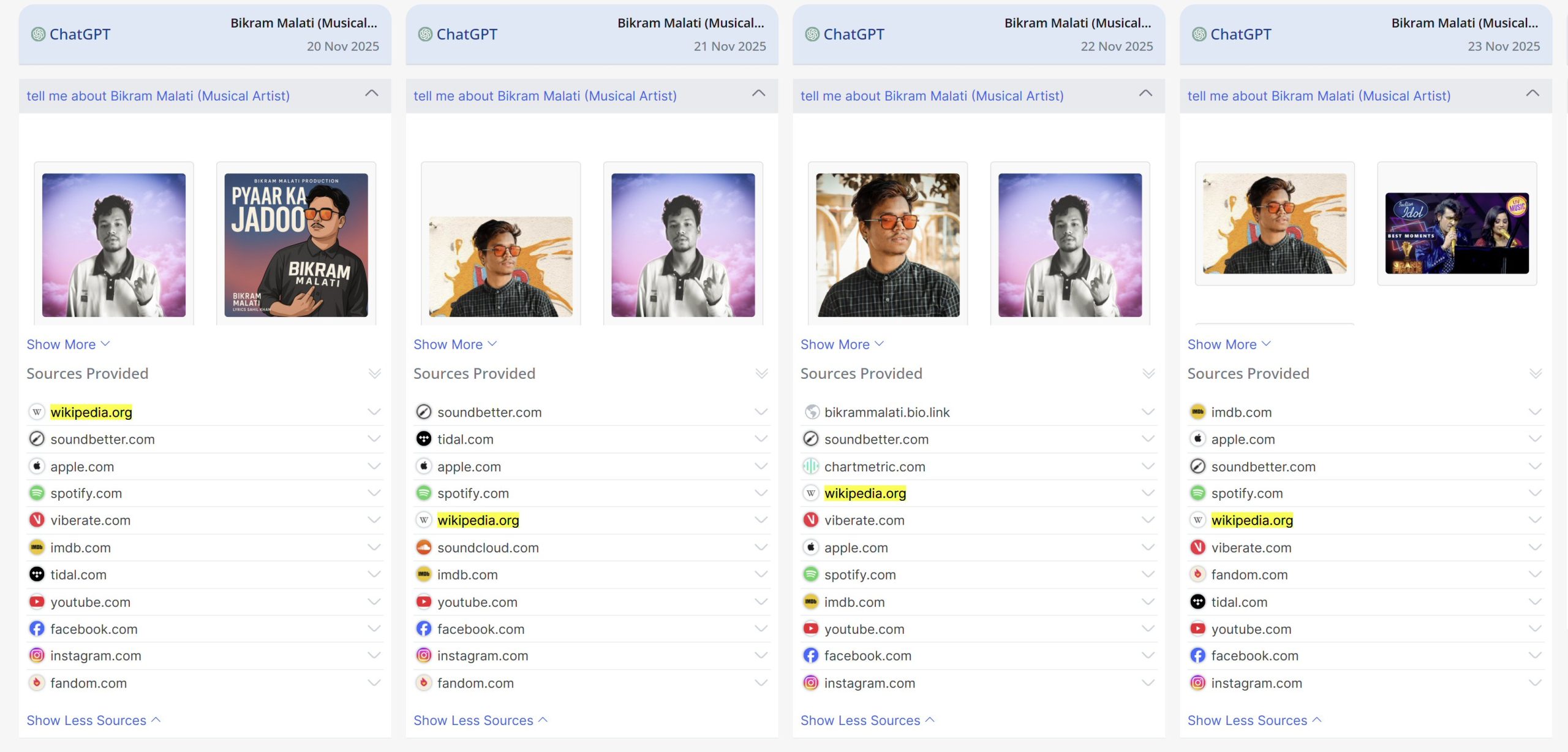
The image below from our AIQ platform shows an example of ChatGPT referencing a deleted Wikipedia page:
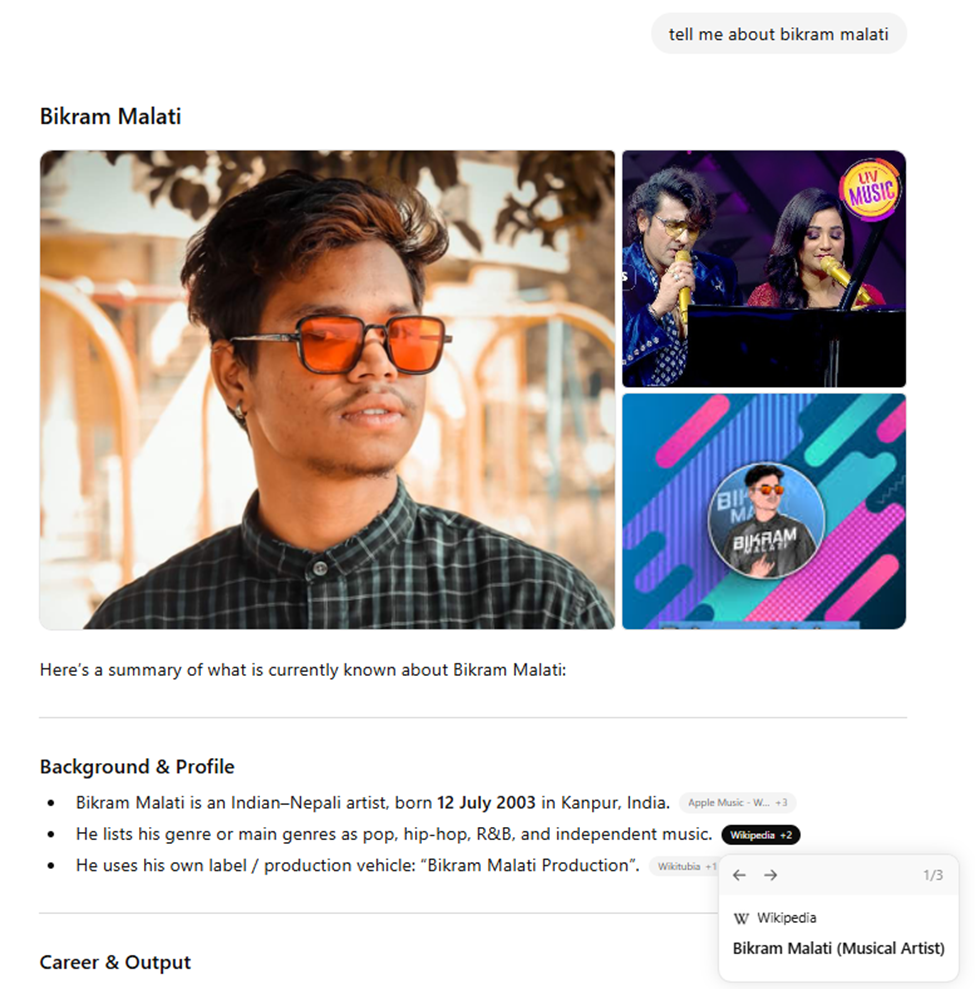
Here is an actual ChatGPT screenshot:
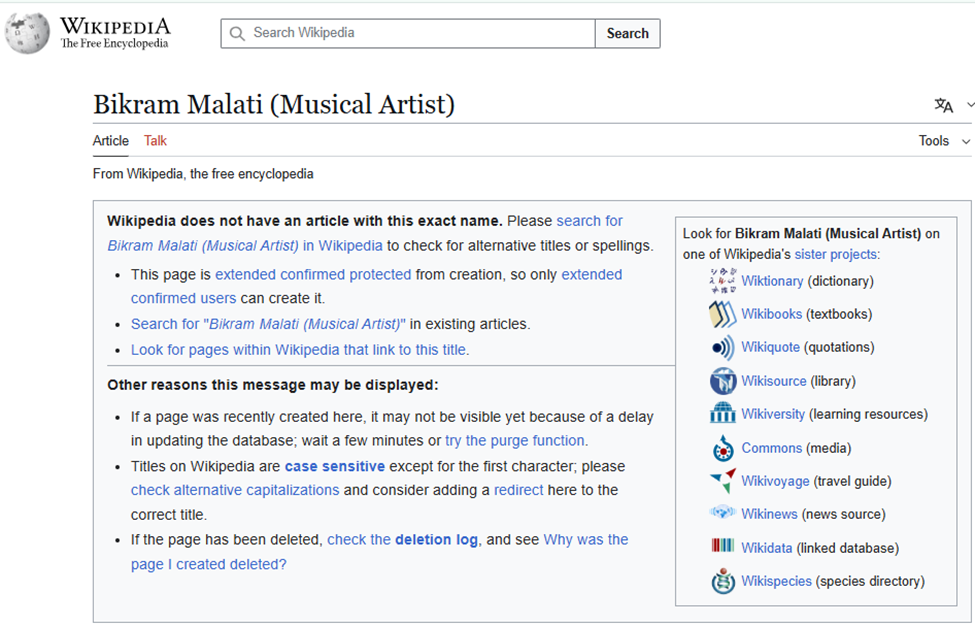
When you click on the link from ChatGPT, you get:
And, here you can see that the Wikipedia article was deleted on May 19th:

2. The Indexing Debate: Google, Bing… or Something Else?
There’s been a lot of discussion online about whether ChatGPT (and similar tools) rely on Google’s or Bing’s index to answer questions about current topics.
Microsoft has described Bing as ChatGPT’s “search partner,” suggesting that when the model browses the web in real time, it’s doing so through Bing’s infrastructure. Others assume that since Google dominates the indexing landscape, much of the information must come from its dataset.
Our finding suggests a third possibility.
AI systems like ChatGPT don’t just rely on live search indices — they also draw on their own internal knowledge, built from snapshots of the web taken during training. That means they may reference pages that have since disappeared, been updated, or were never fully visible to search engines at all.
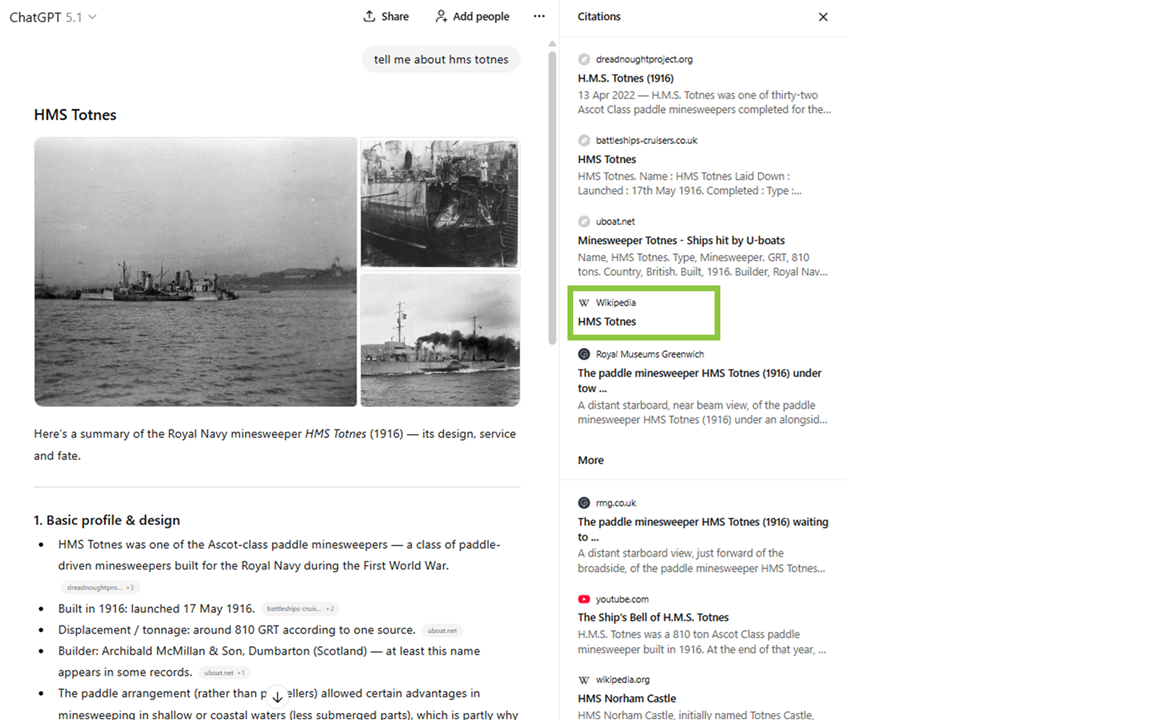
For example, here ChatGPT cites the HMS Totnes Wikipedia page:
However, a Google search for that Wikipedia page shows that it hasn’t been indexed:
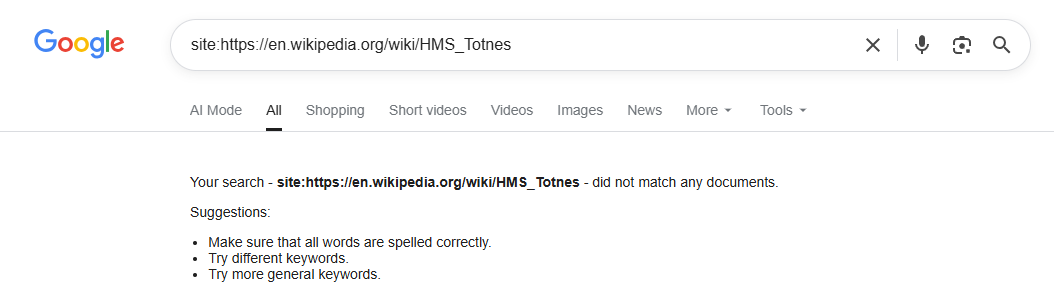
Unlike Google or Bing, which are constantly re-indexing the live web, AI models often retain information indefinitely. They may “remember” content that was once public but has long since vanished — effectively creating a parallel version of the internet that exists only inside the model.
This raises a fascinating question:
If AI can access and resurface information that’s been deleted or de-indexed, what does “control” over your online reputation really mean?
3. The Reputation Implications
For years, Wikipedia has been one of the most powerful determinants of how brands and individuals appear online. It influences Google Knowledge Panels, affects trust signals, and often shapes media narratives.
Because of that, many organizations have worked diligently to ensure that their Wikipedia entries are accurate, balanced, and aligned with verifiable facts. But the assumption has always been: once an error is corrected or a page is deleted, the outdated version fades from public view. In the age of AI, that’s no longer guaranteed.
If ChatGPT or another AI system has already learned from a previous version of a Wikipedia page, that information may continue to influence its responses — even if the page no longer exists. This creates a temporal lag between what’s true now and what AI believes to be true, based on past data.
That lag can have real consequences:
- A company that successfully removes an inaccurate Wikipedia claim may still see it resurface in AI summaries.
- An individual whose biography was corrected might find outdated information repeated in generative search results.
- A brand that relies on Wikipedia for credibility could see outdated or partial content influencing how AI describes it to users.
This represents a profound shift in the mechanics of reputation. Reputation is no longer defined solely by what’s visible online — it’s also shaped by what AI remembers.
This raises an important question: if outdated Wikipedia content can continue to surface in AI responses, is there still value in correcting or deleting a page? The answer is yes — but with new strategic considerations. When an updated version of a page is published, AI systems that re-crawl or refresh their training data are more likely to replace older information with the corrected version. And even if outdated details aren’t fully overwritten everywhere, ensuring that accurate, high-quality content exists increases the probability that AI models will surface the correct version in most contexts. In other words, maintaining an accurate Wikipedia presence still matters — it just operates within a more complex, probabilistic AI ecosystem.
4. Managing Reputation in the Age of AI Memory
So, what should brands and communicators do in this new landscape?
First, recognize that deletion isn’t disappearance.
Once information has entered the public digital ecosystem — especially on high-visibility platforms like Wikipedia — it may continue to circulate in AI models long after being removed. That makes proactive accuracy and clarity even more important. Fixing misinformation quickly reduces the risk that it becomes “baked in” to an AI’s memory.
Second, expand your visibility monitoring beyond search.
Traditional SEO and reputation tools focus on what appears in Google results. But as AI platforms like ChatGPT, Perplexity, and Google’s own AI Overviews become more popular, brands need to track how they’re represented there, too. Five Blocks’ AIQ Snapshot, for example, measures how companies appear across leading AI platforms — providing early warning when narratives diverge from reality.
Third, view Wikipedia through an AI lens.
Wikipedia remains one of the most influential data sources in the world — not just for humans, but for machines. Maintaining accuracy, neutrality, and completeness there matters more than ever, because what’s written (or once written) can echo through AI systems long after.
Finally, stay vigilant about every change that happens on your Wikipedia pages.
Even small edits — a phrasing shift, a new citation, an added controversy — can ripple into AI systems that use Wikipedia as a core reference. That makes real-time monitoring essential. Tools like Five Blocks’ WikiAlerts™ notify brands the moment a page is edited, enabling rapid review and response before inaccurate or biased information spreads or becomes part of an AI model’s reference set. In the age of AI memory, staying updated isn’t just good Wikipedia hygiene — it’s a critical layer of reputation protection.
5. The Takeaway: Reputation in a Post-Search World
The discovery that ChatGPT can cite deleted or unindexed Wikipedia pages is more than a technical curiosity. It’s a signal that we’re entering a post-search era — one where visibility and influence extend beyond the reach of traditional SEO and content control.
Search engines like Google and Bing show us what’s out there today. AI models, in contrast, reveal what’s still in there — the accumulated memory of the internet, with all its imperfections, edits, and ghosts of pages past.
For communicators and reputation professionals, this is both a challenge and an opportunity. It’s a reminder that reputation isn’t static, and it isn’t limited to what’s live. It’s a living narrative, shaped by both current content and the digital traces left behind.
At Five Blocks, we believe the next chapter of reputation management lies in understanding and influencing that AI layer — ensuring that when machines summarize who you are, they get the story right.
Curious whether ChatGPT is pulling from non-indexed or deleted pages that could be influencing your brand narrative? Get an AIQ Snapshot now!
Reputation Crisis Management
Why Five Blocks – and Why It’s the Right Choice for Reputation Crisis
When reputation is on the line, the firm you choose matters more than ever.
Most digital reputation crises share the same fatal flaw: the response comes too late, goes too shallow, or fixes the wrong layer. At Five Blocks, we’ve spent over two decades building a methodology that works precisely because it doesn’t treat a crisis as a moment – it treats it as a system.
Here’s why brands and individuals consistently choose Five Blocks when the stakes are highest.
We Move Fast – Without Cutting Corners
Crisis reputation work demands both speed and substance. Those are usually in tension. At Five Blocks, we’ve solved for both.
Our first move in any crisis engagement is triage: identifying which elements of a client’s digital presence can be improved immediately – owned content updates, structured data corrections, knowledge panel claims, entity signals – and which require a longer runway. We call this our two-pronged approach: pain relief plus permanent repair.
The quick wins are real. We can often move the needle on owned and controlled content within days. But we never stop there. While the client is getting near-term relief, our team is simultaneously working the harder, more durable problems – the ones that will determine how that person or brand looks in Google and in AI-generated responses six months from now.
Everything Starts With Data
The hardest part of managing a brand through a crisis isn’t the execution – it’s getting the client to understand what actually needs to be done.
At Five Blocks, we lead with analysis. Every engagement begins with a comprehensive audit of how a client appears across Google search, AI models (ChatGPT, Claude, Gemini, Perplexity, Copilot, Grok, AI Mode, and AI Overview), Wikipedia, knowledge graphs, and third-party citations. We map the full landscape before we touch a single thing.
This matters for two reasons. First, it gives clients a clear, evidence-based picture of the problem – which builds alignment and gets decisions made faster. Second, it ensures our solutions address root causes, not symptoms. Surface-level fixes collapse under pressure. Structural ones hold.
Our proprietary platforms make this possible at a level of depth most firms can’t match:
IMPACT™
IMPACT™ tracks Google search results daily across tens of thousands of queries, giving clients real-time visibility into which results dominate their brand, name, or other query, and how they shift over time.
AIQ
AIQ monitors how AI models describe a brand across all major platforms – sentiment, source citations, peer comparisons – updated continuously. It is the only tool of its kind built specifically for AI narrative management.
Bespoke Work. In-House. Every Time.
Five Blocks does not outsource. Every piece of work – from Wikipedia research and editing to technical structured data implementation to AI content strategy – is done by our team, all in-house.
This is not an operational detail. It is a quality guarantee.
Our staff averages well over a decade of experience in digital reputation. We have 10+ people dedicated exclusively to Wikipedia, with a depth of knowledge of that platform that is unmatched in the industry. We have low turnover. The person who starts on a client’s account in month one is still there in month six – and they know the case intimately.
In a crisis, continuity and expertise are everything. You cannot afford to have your case managed by a junior associate reading from a playbook. At Five Blocks, senior practitioners are hands-on throughout.
We Work Across Every Layer That Matters
Digital reputation today is not a single channel. It is a system – and in a crisis, every layer of that system gets stress-tested simultaneously.
Five Blocks has deep expertise across all of them:
Google Search
We know how to identify which results are driving reputational harm, how to move positive content up, and how to push damaging results down through content strategy, entity optimization, and technical signals. Our IMPACT™ platform has tracked over 100,000 brand search footprints.
Wikipedia
One of the most powerful – and most misunderstood – platforms in digital reputation. Wikipedia content is cited directly by AI models and influences knowledge panels across Google. We work transparently and ethically within Wikipedia’s policies, disclosing our role as required. Our 13-person Wikipedia team handles everything from notability assessments to complex editorial negotiations.
AI and LLM Narratives
This is the frontier of reputation management, and it is where Five Blocks has invested deeply. AI models like ChatGPT and Claude synthesize a narrative about every brand and individual from the sources they can access – primarily Wikipedia, corporate websites, earned media, and third-party directories. We know how to shape those sources so that the narrative AI builds is accurate, complete, and favorable. Our AIQ platform measures this precisely.
Entity Signals and Structured Data
Wikidata, Crunchbase, Google’s Knowledge Graph, schema markup on corporate websites – these are the underlying signals that AI and search engines use to understand who a person or company is. We have experts who work in all of these environments.
Owned Content
In a crisis, a client’s own website becomes a critical reputation asset. We help clients build content that is structured for both human readers and AI models – detailed, well-sourced, and optimized to become a primary citation source.
We Know How AI Models Think About Your Brand
This is the capability that most reputation firms do not yet have – and it matters more every month.
When someone searches for a brand, an executive, or a company in ChatGPT, Claude, Gemini, or Copilot, the AI constructs a narrative. That narrative is synthesized from what it has read across the web – and it is often incomplete, outdated, or shaped by negative sources the client doesn’t even know exist.
We call this Synthesized Reputation – the AI’s version of who you are, built from the same building blocks that have always mattered in digital reputation: earned media, owned content, Wikipedia, and entity signals. Five Blocks has spent 20 years working on exactly these building blocks. We were doing this work before AI made it urgent.
Our AIQ platform gives clients a real-time window into their AI reputation – how they are described, what sources AI is drawing from, how they compare to peers in the same industry. No other firm offers this at scale.
Peer Analysis Is Built Into Our Methodology
One of our core operating principles: don’t reinvent the wheel.
In every engagement, we analyze what is working for clients’ peers and competitors – which content is getting cited by AI models, which sources are driving positive narratives, which Wikipedia structures are most effective. If something is working, we learn from it. This peer analysis approach, powered by AIQ, accelerates results and ensures our recommendations are grounded in what is actually effective in that industry and competitive context.
Industries and Audiences We Serve
Five Blocks works with Fortune 500 companies, PR firms, hedge funds, private equity firms, insurance companies, banks, pharmaceutical companies, energy companies, higher education institutions, and high-net-worth individuals – including some of the most recognized names in business and public life.
We understand that a pharmaceutical company in the middle of an FDA controversy has different needs than a hedge fund manager dealing with adverse press. We tailor every engagement to the specific context, industry, and stakeholder environment.
What a Five Blocks Crisis Engagement Looks Like
Rapid Audit: Within 48 hours, we deliver a prioritized map of where the reputational damage exists across Google, AI models, Wikipedia, and entity signals.
Triage and Quick Wins: We identify what can be corrected or improved immediately and begin execution.
Strategic Roadmap: We build a structured 90-day plan that addresses both near-term relief and long-term durability.
Continuous Monitoring: IMPACT™ and AIQ track progress daily. Clients always know where they stand.
Senior Oversight Throughout: A senior practitioner is accountable for the engagement from day one through completion.
Frequently Asked Questions
How quickly can Five Blocks respond to a crisis situation?
We can begin a crisis engagement within 24-48 hours of engagement. Our team is structured for rapid mobilization, and we have dedicated capacity for crisis work.
Does Five Blocks work with individuals as well as companies?
Yes. We work with high-net-worth individuals, executives, public figures, and celebrities alongside corporate clients. Individual reputation management has its own specialized methodology, and we have deep experience in it.
What makes Five Blocks different from a general PR firm handling digital reputation?
General PR firms typically manage media relationships. Five Blocks manages the technical and content infrastructure that determines what the internet – and AI – says about you. These are different skills, different tools, and different expertise. Most PR firms partner with us rather than compete with us.
Can Five Blocks actually change what AI models say about a client?
Yes – through legitimate, structural means. We improve the underlying sources that AI models read: corporate website content, Wikipedia, earned media citations, entity signals. When those sources improve, AI-generated narratives improve. This is not a hack or a workaround. It is how AI reputation management works.
Do you outsource any of your work?
No. All Five Blocks work is done in-house by our team. We do not use white-label vendors or offshore execution.
How much does a Five Blocks crisis engagement cost?
Crisis engagements are structured as monthly retainers, typically ranging from $15,000 to $30,000 per month depending on scope and resourcing. Some situations resolve in one to two months; engagements involving larger companies or sustained news cycles often run six months or longer. Fees are tied directly to the scope of the work and the resources required to execute it.
How quickly will we see measurable results?
In most engagements, we see measurable impact within the first one to two weeks, with significant improvements over the course of two to three months. Full programs can run longer because the goal is not a band-aid – it is a durable, long-term solution that holds up after the immediate crisis subsides.
What types of crises does Five Blocks handle?
We work on crisis situations for both brands and individuals. On the brand side, this includes transactions, poor earnings, safety concerns, product recalls, negative product reviews, and broader industry-related issues. For individuals, we handle negative press, defamation, and other reputation challenges that surface in search and AI results.
Does Five Blocks remove negative content from the internet?
Whenever it is possible and appropriate, yes. We pursue removals through direct outreach to site owners, factual correction requests, and – in cases where a defunct site is hosting defamatory content – we have even purchased sites and blogs on behalf of clients. Where a legal angle exists, we advise clients on how to use it. Removal is not always feasible, which is why our broader methodology focuses on shaping what surfaces in Google and AI results regardless.
Yes. All of our work is confidential, without exception.
How does Five Blocks report progress to clients?
Clients receive formal progress reports on a monthly cadence, supplemented by weekly and ad-hoc updates as activities and developments occur. IMPACT™ and AIQ provide continuous, real-time visibility into Google search results and AI narratives, so clients always have a current picture of where they stand.
How is Five Blocks different from traditional ORM or suppression firms?
Traditional ORM firms tend to fight the algorithm. We work with the platforms. Our team understands where Google and AI models source their content and how they prioritize it, and we help clients ensure that their preferred narrative, stories, and links are seen and prioritized within those systems. We work hand-in-hand with clients’ CCOs and PR teams to curate that narrative – not against the algorithm or AI logic, but in alignment with how it actually works.
Do you work with clients outside the United States?
Yes. We work across many languages and countries, including French, German, Spanish, Italian, Japanese, and others. Our international offices give us native depth in multiple markets, and our methodology adapts to the search and AI ecosystems clients face in their specific geographies.
What happens after a crisis engagement ends?
It depends on the client. In some cases, once the crisis is resolved, no further work is needed. For companies and organizations with ongoing news cycles – where the same stories can resurface – we offer ongoing maintenance programs to keep the preferred narrative durable over time.
Can Five Blocks move existing negative results off page one of Google?
Yes – and we do it primarily by curating a client’s broader online presence rather than by attacking the negative results directly. That means making preferred content robust, readable by Google and AI models, and optimized to surface. We study what is working for peers, and we seize every opportunity available – website changes, new profiles, video content, images, FAQs, articles on third-party sites, earned media. PR and comms do their work; we do the technical, structural, and content optimization work hands-on, and the two together move the results.
Ready to talk? Contact us to discuss your situation – whether you are in an active crisis or building defenses before one arrives.
