What should a reputation management firm’s discovery process look like?
A rigorous discovery process includes a client-context conversation, a digital-landscape diagnostic covering SERP results, AI engine narratives, Wikipedia, and entity signals, stakeholder interviews where relevant, a prioritization framework (damage vs. quick wins), a written assessment, and a recommendation with proposed scope tied to specific objectives. A firm that skips the diagnostic and jumps straight to a pitch is selling before it understands the problem.
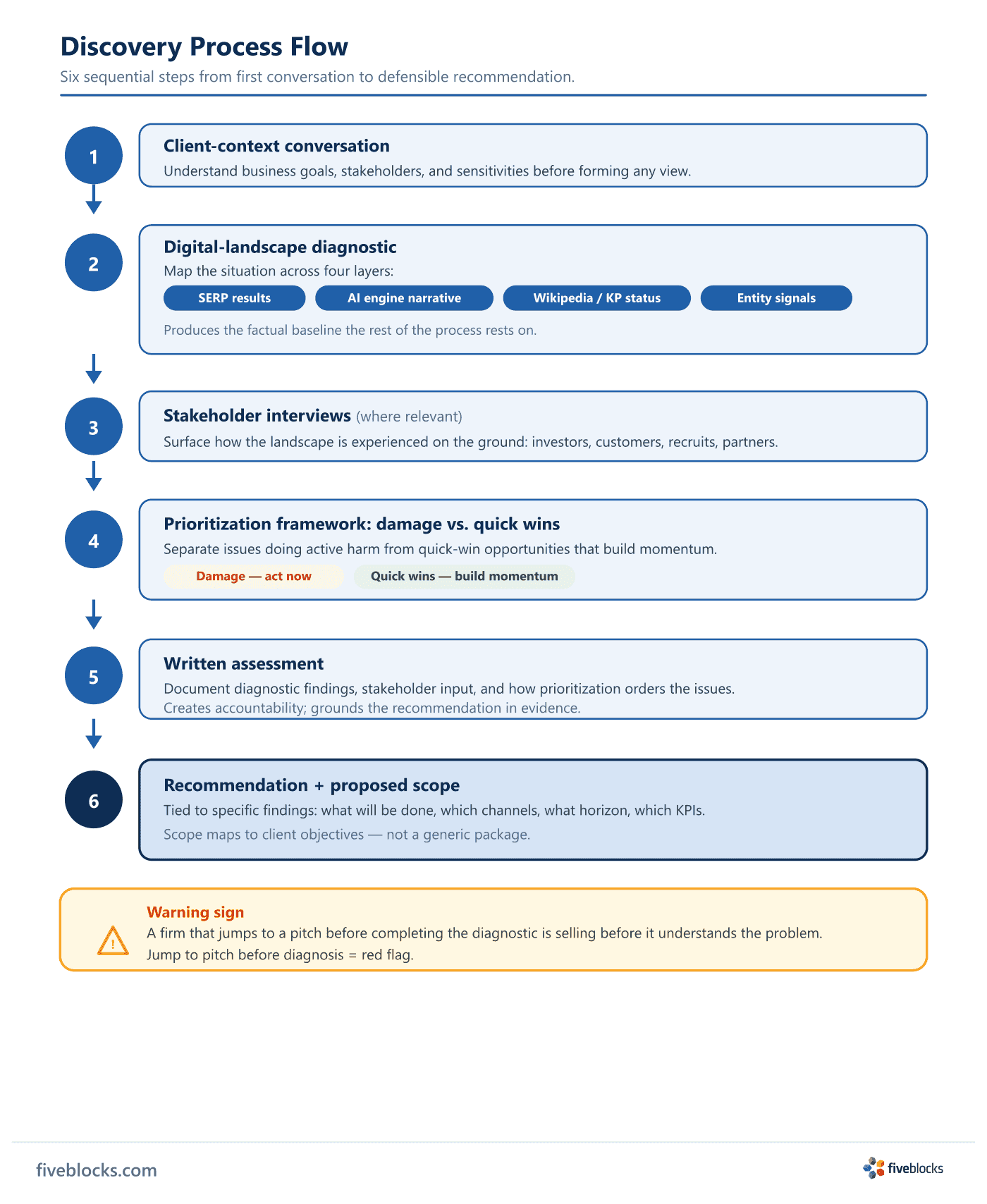
A reputation firm’s discovery process shows how it thinks, and a rigorous one is a sign of seriousness in itself, because the diagnosis determines the quality of everything that follows. A sound process moves through six steps in order.
-
Client-context conversation
The firm starts by understanding the business, its goals, its stakeholders, and the sensitivities in play, before forming any view of the situation. Everything downstream depends on it. Skip it and the diagnostic begins without the context needed to interpret what it finds.
-
Digital-landscape diagnostic
The firm maps the situation across four layers: the branded result set on priority SERP queries; the AI engine narrative (what ChatGPT, Gemini, Copilot, Perplexity, and other engines say about the entity); the Wikipedia article and Knowledge Panel status; and the entity signals (schema, structured data, and authoritative references) that drive how information systems resolve the entity. This is the factual baseline the rest of the process rests on.
-
Stakeholder interviews (where relevant)
Where the reputation is visibly affecting investors, customers, recruits, or partners, structured interviews surface how the situation is being experienced on the ground. This qualitative layer often reveals damage that the digital data alone does not fully capture.
-
Prioritization framework: damage vs. quick wins
With the diagnostic in hand, the firm separates the issues doing active harm (hostile content in prominent positions, an inaccurate AI narrative, a missing or wrong Knowledge Panel) from the opportunities that can be addressed quickly and build momentum. Both categories belong in a sound plan, but they carry different urgency and need different resourcing.
-
Written assessment
The findings go into a written assessment: what the diagnostic found, what the stakeholder input revealed, and how the prioritization framework orders the issues. Writing it down creates accountability and gives the client a reference point. It also keeps the recommendation that follows tied to evidence rather than assertion.
-
Recommendation and proposed scope
The process closes with a recommendation tied to the specific findings and a proposed scope that maps to the client’s objectives rather than a generic package. The scope should say what will be done, on which channels, over what horizon, and against which KPIs, so the client can judge it concretely.
Warning sign: a firm that skips the diagnostic and jumps straight to a pitch is selling before it understands the problem. Discovery is the work that makes everything else defensible.
Last reviewed: 20/05/2026
