How do you manage reputation after a data breach?
After a data breach, the customer-facing FAQ page on the company's own site is the single most important reputation asset: it becomes the property the press and AI engines cite, and it must be kept current as remediation progresses. Pair it with daily AIQ monitoring for misinformation and continued owned content for the months after the news cycle ends, because breach articles persist in AI engines long after press interest fades.
Data breach reputation work comes down to being the most credible, current source on your own incident. When a breach ends up a footnote rather than a defining association, it is usually because the company controlled the information environment around the event well.
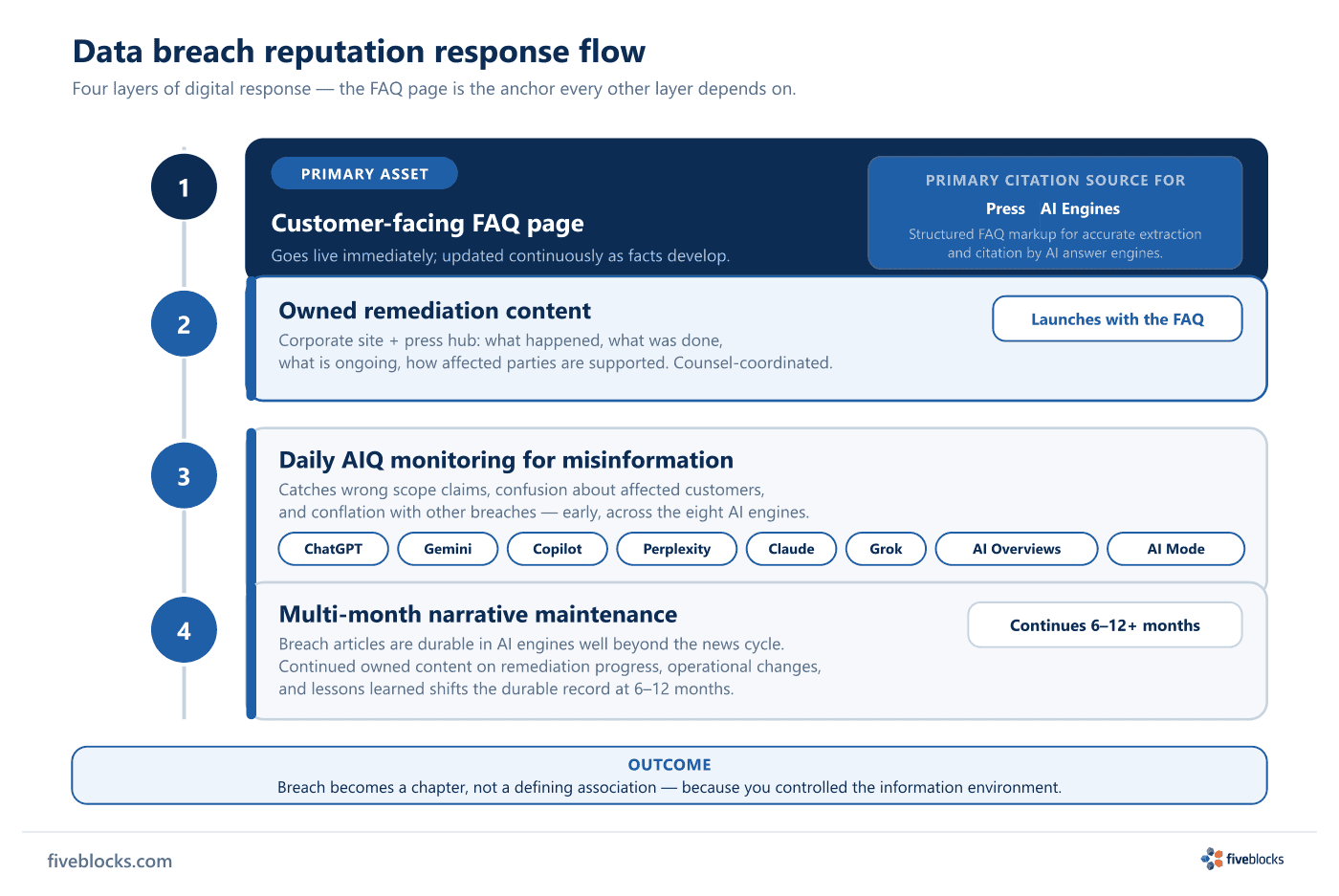
Step 1: launch a customer-facing FAQ page immediately
The FAQ page on the company’s owned site is the single most important asset in a breach response. It answers the questions stakeholders are actually searching for in clear, current language, and it becomes the property the press and AI engines cite when covering the event. It has to go live quickly and update as facts develop. Structured with clean headings and FAQ markup, it is built so AI engines can extract and cite it accurately.
Step 2: produce regulatory-aware remediation content
Owned content on the corporate site and press hub covers the sequence: what happened, what was done immediately, what is being done on an ongoing basis, and how affected parties are being supported. The language is coordinated with counsel to stay within what can be disclosed at each stage. Vague or jargon-heavy remediation content reads as evasive and tends to prompt more hostile coverage. Specific, factual statements on concrete steps work better in both the press and the AI engines.
Step 3: run AIQ monitoring daily
Misinformation spreads quickly in the first days of a breach: wrong scope claims, confusion about which customers are affected, conflation with other companies’ breaches. Daily AIQ monitoring across eight major AI engines catches this early and shows which sources each engine weights. Where engines amplify inaccurate framing, the fix is authoritative correction at the source level so the engines have better material to draw on.
Step 4: maintain the narrative for months
Breach articles stay in AI engines and search results well beyond the news cycle. The company’s continued statements on remediation progress and resolution feed the longer-term narrative. Owned content about what changed operationally, what was learned, and how the company functions differently afterward becomes the record stakeholders find when they search the issue six or twelve months later. Work that stops at the end of the press cycle usually leaves the breach as the dominant association. Sustained content work over months is what shifts that.
The pattern: companies that handle it well vs. those that don’t
- Handle it well: Fast, factual, current FAQ page. Specific remediation content updated as facts develop. Daily monitoring for misinformation. Sustained owned content after the news cycle ends. The breach becomes a chapter.
- Handle it poorly: Slow or vague initial response. No clear customer-facing information hub. Monitoring stops when press interest fades. The AI engines consolidate the breach as the defining frame and hold it there.
Last reviewed: 19/05/2026
