How do you build search reputation in a new market or region?
Quick answer
Building search reputation in a new market means rebuilding four layers locally: localized entity signals, authoritative regional coverage, country-aware content and structured data, and search-and-AI monitoring in the local language.
International expansion is a common point where an existing reputation does not transfer cleanly. A brand that is well established in its home market can be close to invisible, or inaccurately represented, the moment a stakeholder searches from a new country. Rebuilding it runs across four layers.
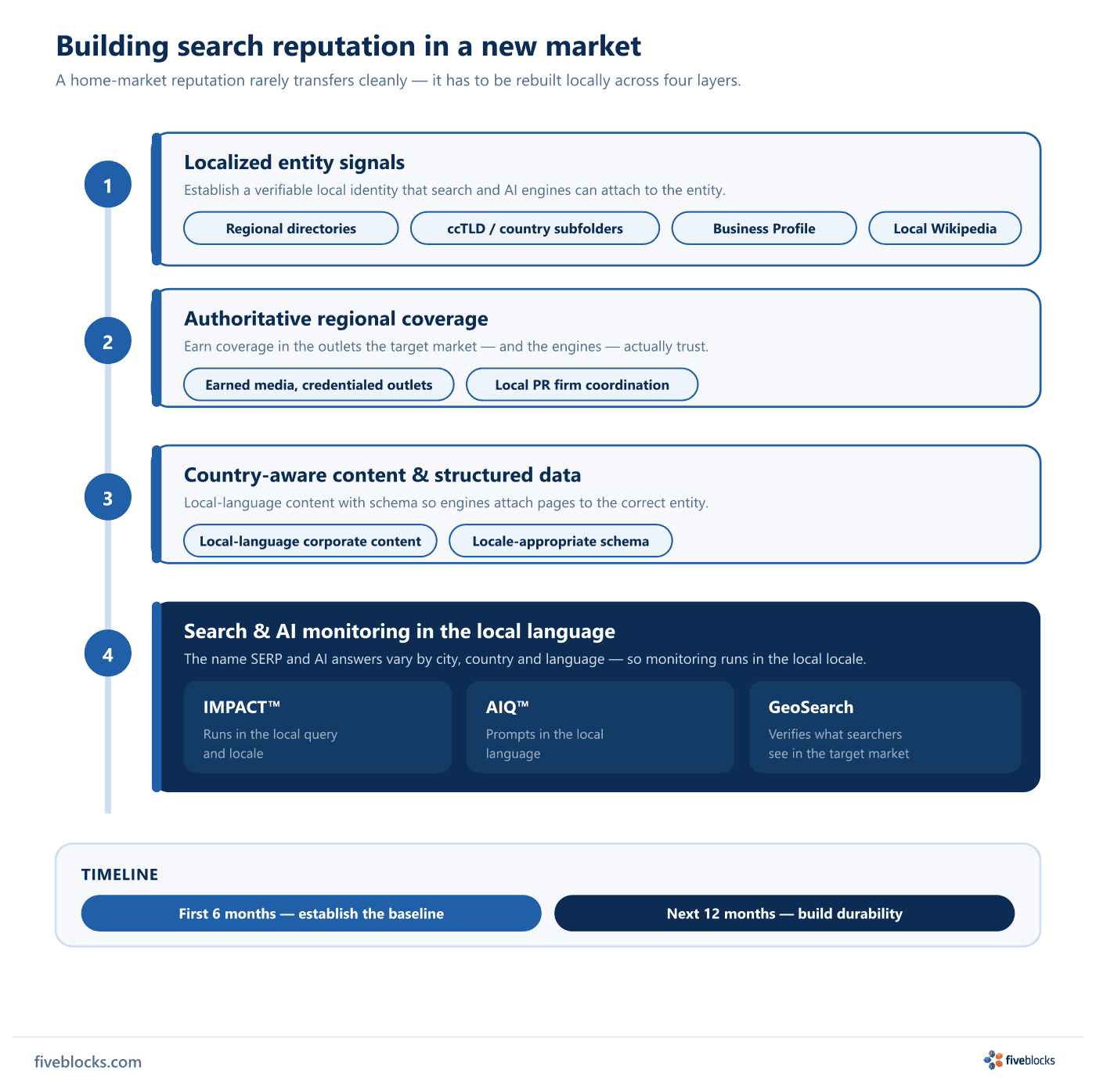
The four layers of a new-market build
- Localized entity signals – regional directory listings, a ccTLD presence or country-specific subfolders, a Google Business Profile where applicable, and regional Wikipedia language versions where notability supports them. Wikipedia operates in roughly 300 language versions linked through Wikidata to the same underlying entity, so the local-language article and the entity layer behind it both matter.
- Authoritative regional coverage – earned media in credentialed outlets in the target market, often coordinated with a local PR firm that knows which publications the market and the engines trust.
- Country-aware content and structured data – region-specific corporate content in the local language, with schema markup appropriate to the locale. Structured data helps search and AI engines understand what a page asserts and attach it to the correct entity, which determines whether the local content is surfaced at all.
- Search and AI monitoring in the local language: IMPACT™ runs in the local query and locale, AIQ uses prompts in the local language, and GeoSearch verifies what searchers see in the target market. The name SERP varies substantially by city and country, and AI engines respond differently to the same question depending on language and country.
Timeline
The first six months establish the baseline across these four layers; the next twelve build the durability that lets the local reputation hold up the way the home-market one does.
Last reviewed: 19/05/2026
